

Top 10 Cheap Dodge Challenger Mods Every Owner Should Install
Most Challenger owners drop their first thousand dollars on an exhaust and a tune — and we get it, those upgrades are satisfying. But according to a Mopar mechanic with more than 25 years on Dodge and Ram vehicles, it’s the overlooked $20–$150 parts that decide whether your car stays clean, reliable, and worth money. Skip them and you’re looking at damaged paint, a dead battery, or a repair bill that never had to happen.
We’ve pulled together all ten upgrades from the video below, ranked exactly the way the video’s host presents them — from the smart baseline protections up to the engine issue every 5.7 Hemi owner needs to know about. We cover which trims and model years each mod fits, what you can realistically expect to pay, and which marketing promises to take with a grain of salt. As always, mods can affect your factory warranty, and some items — particularly the skip shift eliminator — may be restricted by local emissions or noise regulations, so check your local rules before you buy.
Ready? Here are the top 10 cheap Dodge Challenger mods every owner should install, starting with number ten and building toward the one the video’s host calls the most important of all.
Based on the video above. Specs, prices and dates are as stated in the video and may have changed, so confirm anything important before you rely on it.
10. Bluetooth OBD-II Scanner
A check engine light doesn’t automatically mean a dealer visit, and a Bluetooth OBD-II scanner is the tool that proves it. The video’s host highlights the BlueDriver, which plugs into the port under the dash and pairs with your phone. According to AutomoBlog, it typically costs just under $100, and the host found sale listings running from about $70 to $120. The maker says it reads engine, ABS, airbag, and transmission codes with no subscription required.
The host tells the story of an owner convinced his transmission was failing — the code turned out to be a loose gas cap. Before you buy, confirm the app supports your phone OS and that Dodge vehicles are covered. We’d also recommend photographing every code before you clear it, because clearing erases the history a mechanic will need later. The host adds one habit worth building: check live data while the car runs fine so you know what “normal” looks like before something goes wrong.
9. Molded Floor Liners
Floor liners look like a cosmetic upgrade, but their real job is keeping water, salt, and mud out of your carpet. According to the video’s host, a wet carpet is what quietly destroys a Challenger’s interior value — and a buyer notices the smell in about ten seconds. He points to WeatherTech digital fit liners, which are laser-measured for the car. NAPA lists the front set for 2015 through 2023 Challengers at about $118, and American Muscle lists a rear pair for 2011 through 2023 around $70.
Check the generation before you order — fronts are year-specific, and the host notes that one retailer says a 2015-and-up front liner does not fit the GT trim. Deep channels trap liquid instead of letting it spread. We’d pull the liners out twice a year, wash them, and check the carpet underneath for any dampness while they’re out. It’s cheap protection for the part of the car you simply can’t repaint.
8. Wheel Locks
It’s easy to assume nobody bothers stealing wheels off a heavy muscle car, but the video’s host points out that a thief only needs a lug wrench and a few minutes. Wheel locks swap one nut per wheel for one that requires a keyed socket. American Muscle lists a McGard black set for the Challenger at about $58, and Mopar’s own kit shows up at around $94.
The host flags one important gotcha: picture yourself with a flat on a road trip and the key socket sitting in a kitchen drawer at home — your theft deterrent just became a tow. The thread size American Muscle lists for 2008 through 2023 Challengers is 14×1.5; confirm this for your specific year. Also check whether your wheels are factory or aftermarket, because the lower-priced acorn locks at around $19 fit aftermarket wheels only. Keep the key socket somewhere you’ll always have it — the glove box, your everyday bag, your roadside kit.
7. Front Strut Tower Brace
A front strut tower brace ties the two strut towers together so the front of the body flexes less when the suspension loads up in a corner. The video’s host sets honest expectations here: owners often expect a night-and-day change, and what you actually get is a small, real improvement in feel. It’s worth noting that Mopar thought well enough of the idea to fit front and rear braces on the 2010 Mopar 10 Challenger. American Muscle lists a CNL brace at about $145 and a BMR brace around $300.
Fitment matters here. The host says the CNL brace does not fit the V6, the Shaker hood, or the 6.2 Hemi, and BMR notes that the 5.7’s engine cover has to come off for installation. Handling claims from manufacturers are claims, not independent lab results, so we’d treat this as a feel mod and buy it only if the tactile improvement is what you’re after. Torque it to spec once it’s on.
6. Cold Air Intake
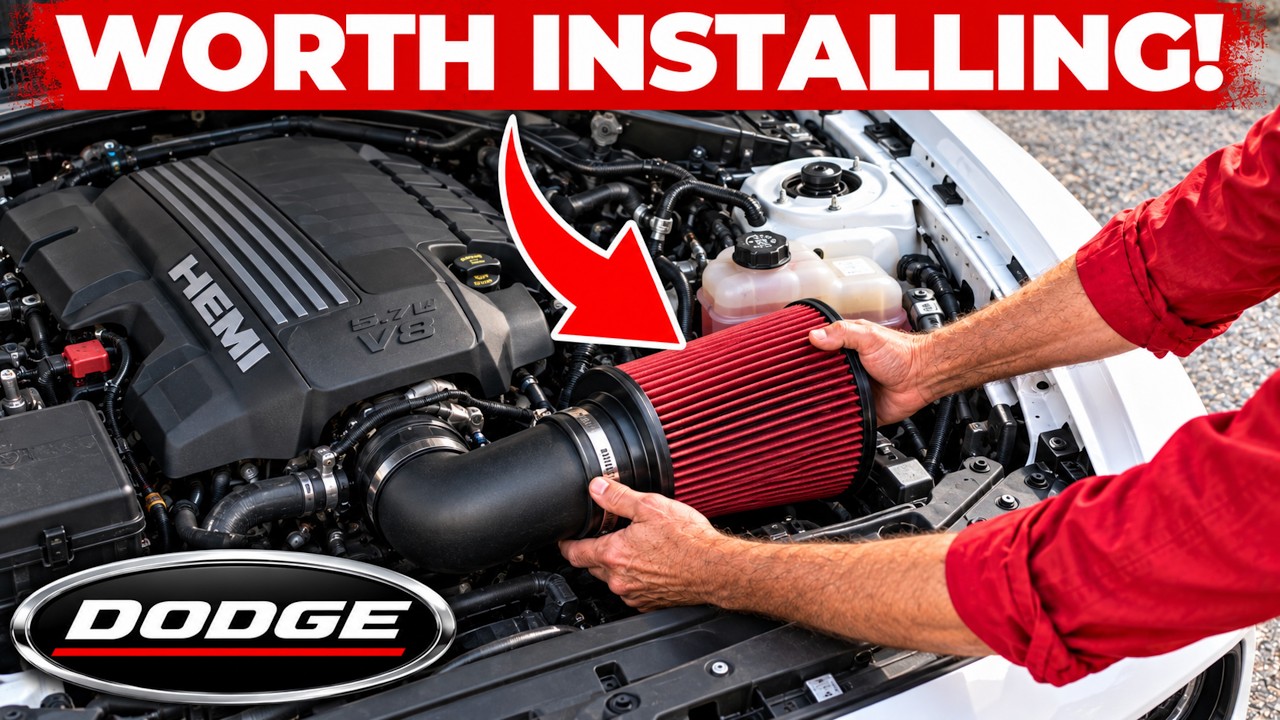
Few mods come with bigger myths attached than the cold air intake, and the video’s host addresses them directly. An intake swaps the factory airbox for a larger filter and a smoother tube. JLT claims 10 to 15 horsepower on a stock 5.7 for about $349, and K&N estimates 19.6 hp for its Next Gen unit at around $550. The host is explicit: those are manufacturer numbers, not independent test results, so we’d buy an intake for the improved sound and throttle feel rather than chasing big power numbers.
Fitment varies — Shaker hood cars and 392 Scat Packs use different parts than a standard 5.7 R/T, so confirm before ordering. The host estimates about 90 minutes with hand tools. He also addresses the oil catch can question that often comes up alongside intake installs: the 5.7 Hemi is port injected, meaning fuel washes the intake valves, so according to the host and Slash Gear, a catch can isn’t required on this engine. A note on warranty: an intake is one of the more visible modifications and can be a factor in powertrain warranty discussions, so it’s worth understanding your coverage before you install.
5. Splash Guards
Owners often write mud flaps off as purely cosmetic, but the video’s host makes the case plainly: your tires throw gravel at the lower doors and rear quarters on every drive, and guards stop the stones before they reach paint. Mopar’s own deluxe molded set comes in at about $65 for a 2017 car, and the host found aftermarket four-piece sets on Walmart listings running from about $17 to $56.
Three things to check before ordering: Widebody Challengers need their own guards — don’t order a standard set. Most sets use factory mounting points, and one buyer review the host cites estimates about an hour for installation. Bolt them on once and the paint stays clean through every season.
4. Splitter Guards
The Challenger sits low in front, and that front lip meets every steep driveway first. Splitter guards take the scrape instead of the lip. The video’s host points to ZL1 Addons, which sells splitter guards for 2015 through 2021 Challengers at about $58 — essentially five washers and five adapters positioned to absorb the impact. Stick-on lip protectors from eBay and Walmart sellers run about $18 to $39.
Check the lip thickness before ordering; the listing the host references says a half-inch lip works on a Scat Pack. The ZL1 Addons kit does not fit a Widebody, so confirm your trim. For any adhesive-based option, clean the plastic thoroughly before application. Either way, it’s dramatically cheaper than a bumper repair after one late-night driveway misjudgment.
3. Battery Maintainer
When a Challenger dies after sitting, owners tend to blame the battery — but the video’s host explains that the real culprit is often a parasitic draw pulling power with the key off. Car Complaints lists battery discharging among the top reported problems on the 2011 Challenger, and Fender Bender documented a 2011 Challenger pulling nearly 2 amps with the car shut off. A maintainer keeps the battery at full charge during storage. Walmart lists an EverStart Automotive Maintainer at around $22, and a 4-amp Battery Tender runs near $70. The host specifically says not to buy the small “Junior” unit because it’s built for powersports batteries, not car batteries.
The host draws a clear line: a maintainer holds charge, but it does not fix a draw. If the battery keeps dying even with a maintainer connected, get a parasitic draw test at a shop. We’d treat these as two separate problems with two separate solutions. And don’t limit this habit to winter — any time the car sits for weeks, the host recommends hooking the maintainer up every time. A battery that sits low repeatedly gets weaker each cycle.
2. Skip Shift Eliminator (Six-Speed Manual Cars Only)
This one applies only to Challengers equipped with a six-speed manual transmission. If you’ve ever reached for second gear at light throttle and felt the lever refuse to go there, the gearbox isn’t broken — a solenoid is actively blocking the gate, forcing you into fourth to satisfy EPA fuel economy requirements. Street Muscle’s testers called that forced shift to fourth gear scary at times and couldn’t confirm it actually helps real-world mileage. A skip shift eliminator simply plugs in where the solenoid connects, so the lever is never blocked. Speed Logix lists one for 2009 through 2023 Challengers at about $19.
One critical warning from the host: check the connector carefully. Speed Logix warns that plugging into the reverse solenoid instead of the skip shift solenoid makes reverse hard to engage. These eliminators are sold labeled for off-road use, so check your local emissions and vehicle modification regulations before installing. At $19, it’s the cheapest fix on the list if you’re rowing your own gears.
1. Exhaust Manifold Hardware
The video’s host calls this the most important upgrade on the list, and his reasoning is worth understanding fully. On a 5.7 Hemi, that cold-start tick owners hear and immediately worry about is very often not a lifter problem — it’s an exhaust leak. According to BD Diesel’s tech blog, the tick is loudest right after startup and then fades as the manifold warms up and expands. The mechanical reason: a cast iron manifold is bolted to an aluminum cylinder head, and those two metals expand at different rates with every heat cycle. Over years, the studs get pulled sideways slightly on every drive, fatigue, and eventually snap. When a stud breaks, the manifold lifts, the gasket leaks, and the tick appears. Owners frequently report broken studs at the rear of the manifold in particular, and a loose heat shield on a cold engine is one common sign.
The host walks through a free diagnostic test: let the car sit overnight, start it cold, and listen near the front fenders. A sharp, fast tick right at startup that fades after about ten minutes of warm-up — following engine speed as it does — points to the manifold. If the tick stays or gets louder with heat, that’s a different story; valve train noise doesn’t behave the same way, and the host notes that owners on forums report lifter and camshaft failures on some 5.7s, so get it properly diagnosed. A second check: with the engine fully cold and off, gently tug the corners of the heat shield. A loose shield often means a broken stud behind it. Never touch the exhaust when warm.
The fix isn’t free, but catching it early is far cheaper than waiting. Upgraded bolt kits such as ARP header bolts list around $46 to $90 — confirm fit for your model year. American Muscle estimates about four hours of labor on a 2009 through 2012 Challenger, and shop bills the host has seen run from about $500 to $950. The host recommends replacing gaskets and hardware together and having the manifolds resurfaced at the same time — one machine shop quoted around $75 per pair for resurfacing. Fix it early and you avoid the much worse job of drilling a broken stud out of the head.
Tips and Best Practices
The video’s host closes with a priority framework we think is worth following. Protect the car first — splash guards, splitter guards, floor liners, wheel locks, and a battery maintainer form the foundation. Add performance feel next — the strut tower brace and cold air intake once the basics are covered. Fix the Hemi tick before anything else if you have a 5.7 and you’ve heard that cold-start sound. As the host puts it, every other mod on this list protects the car; the exhaust manifold hardware protects the engine. Always confirm fitment for your specific model year and trim before ordering — several items on this list have widebody exclusions or trim-specific variations. Keep receipts and records of every repair and modification, since that documentation helps the next owner and supports resale value. And for any modification that touches emissions equipment or drivetrain components, verify your local regulations first.
Frequently Asked Questions
Do these mods void my Dodge Challenger warranty?
Modifications can affect your factory warranty, depending on what’s changed and what fails. Under the Magnuson-Moss Warranty Act, a dealer generally must show that a modification caused the specific failure to deny a warranty claim — but that’s a legal nuance, not a guarantee. A cold air intake is a more visible change than floor liners, and a tune touches more systems than a battery maintainer. We’d recommend reviewing your warranty documentation and speaking with your dealer before installing anything that alters airflow, exhaust, or drivetrain components.
Which of these mods fit all Challenger generations, and which are trim-specific?
The OBD-II scanner, battery maintainer, and skip shift eliminator (manual cars only) are broadly compatible across generations, though always confirm connector compatibility. Floor liners, wheel locks, splash guards, and splitter guards have year-range and trim-specific fitment — Widebody cars in particular need their own versions of several items. The strut tower brace has known exclusions including the V6, Shaker hood cars, and the 6.2 Hemi. Check the retailer’s fitment guide for your exact model year and trim before ordering anything.
Is the cold-start tick on a 5.7 Hemi always an exhaust manifold issue?
Not always, which is why the video’s host recommends a specific diagnostic before spending any money. The pattern that points to a manifold leak is a sharp, fast tick at cold start that fades as the engine warms up over roughly ten minutes. If the tick stays constant or grows louder with heat, that behavior doesn’t match the manifold explanation, and the host cautions that some 5.7s have experienced lifter and camshaft failures — a separate and more serious problem. When in doubt, describe the exact sound and timing to a qualified shop rather than guessing.
Do I need a catch can on a 5.7 Hemi cold air intake install?
According to the video’s host, citing Slash Gear, the answer for the 5.7 is no — the engine is port injected, which means fuel washes the intake valves as part of normal operation, so a catch can isn’t required. Direct-injected engines are a different situation because fuel doesn’t wash the valves, making carbon buildup a real concern. If you’re unsure which injection system your specific Challenger uses, your owner’s manual or a quick call to your dealer will confirm it.
Got your Challenger protected and running clean? We’d love to see your build — head over to the Member Garage and share your setup with the rest of the community. For more Challenger-focused content, explore the Challenger Blog for related posts on maintenance, builds, and everything that keeps the legend on the road.
Related Reading
- 2023 Dodge Challenger Hellcat Jailbreak Review: What You Need to Know
- Every Dodge Challenger Trim Explained (2015–2023): Complete Guide
- Dodge Challenger Model Year Buying Guide: 4 Years Ranked
Some links in this post are affiliate links, which means the club may earn a small commission at no extra cost to you. Read our affiliate disclosure.
Talk Challengers with fellow owners in our Facebook group, and got a build to show off? Submit your Challenger to the Member Garage.