
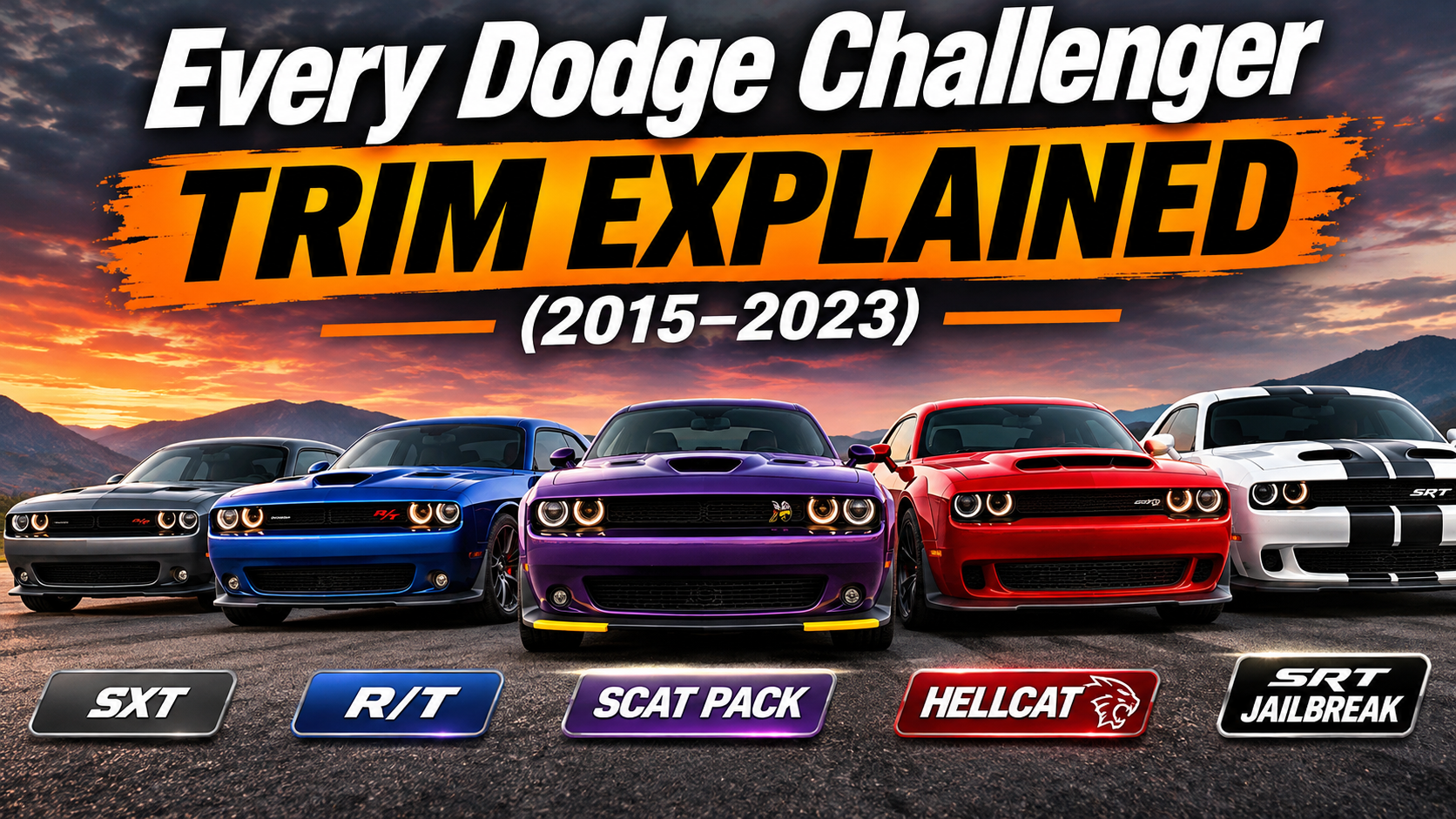
Every Dodge Challenger Trim Explained (2015–2023): Complete Guide
Whether you’re shopping for your first Challenger, upgrading from one trim to the next, or simply want to settle an argument in the parking lot at a cruise night, knowing the differences between every trim level is essential knowledge for any serious enthusiast. The 2015 refresh locked in the Challenger’s iconic look for the rest of its production run, and from that point forward Dodge stacked the lineup with everything from sensible V6 daily drivers all the way up to a factory 1,025-horsepower monster that redefined what a street-legal muscle car could be.
At The Dodge Challenger Club, we cover the full spectrum — SXT, GT, R/T, Scat Pack, Hellcat, Redeye, Demon, and every special edition in between. Our community includes owners of every single one of these trims, and we hear the same questions constantly: What’s the real difference between a Hellcat and a Redeye? Is the Scat Pack worth it over the R/T? What did the Demon actually come with from the factory? This guide answers all of it, trim by trim, engine by engine, so you can walk into any conversation — or any dealership — with confidence.
Below we break down every Dodge Challenger trim from 2015 to 2023, including the special editions and limited runs that share engines with their siblings. Bookmark this one — it’s the reference our members keep coming back to. You can also browse builds from owners across every trim level in our Member Garage for real-world inspiration.

Dodge Challenger SXT — The Accessible Entry Point
The Dodge Challenger SXT is the trim that gets the most people into the Challenger family, and there’s nothing wrong with that. Under the hood sits Dodge’s proven Pentastar 3.6L V6 engine producing 303 horsepower and 268 lb-ft of torque. It’s not going to win a drag race against its V8 siblings, but it delivers a genuinely enjoyable driving experience with far better fuel economy and lower insurance costs than anything higher up the ladder.
The trade-offs are real, though. The SXT comes with cloth seats, smaller steel-style silver wheels, and a smaller Uconnect infotainment system that lacks some of the features found on higher trims. If you’re using an SXT as a daily driver or a first Challenger, it’s a smart starting point — and it responds well to bolt-on upgrades. A cold air intake and a cat-back exhaust can wake up even the V6 and give it a voice. Just be aware that modifications can affect your factory warranty, so confirm with your dealer before you start wrenching.
Dodge Challenger GT — V6 With More Style and Features
The Dodge Challenger GT shares the same 3.6L Pentastar V6 as the SXT — same 303 horsepower, same torque output — but Dodge dressed it up considerably. You get the larger Uconnect infotainment system, upgraded wheels, and most notably a more aggressive hood scoop that gives the GT a noticeably sportier appearance on the street.
Inside, the GT steps things up meaningfully with the choice of leather or suede seating surfaces, and the options list opens up to include lane-assist technology and a sunroof. For buyers who want the visual aggression of the Challenger without committing to V8 fuel and insurance costs, the GT hits a genuinely satisfying sweet spot. It’s a trim we see a lot of our members daily-drive year-round without complaints. If you’re picking up a GT and want to dress it up further, a front splitter can sharpen the look nicely without touching the drivetrain.
Dodge Challenger R/T — The Entry Point Into V8 Territory
This is where the Challenger conversation gets serious. The Dodge Challenger R/T is powered by a naturally aspirated 5.7L V8 Hemi producing 375 horsepower, and it represents the first step into true American muscle for Challenger buyers who refuse to settle for anything without eight cylinders. And “slowest V8 Challenger” is relative — this car will get to 60 mph in around 5 seconds flat, which is quicker than most people realize until they’re already past the intersection.
One feature a lot of enthusiasts really appreciate on the R/T: it’s available with a six-speed manual transmission. In a world where manuals are disappearing fast, being able to row your own gears in a 375-horsepower Challenger is a genuinely special thing. It’s also worth knowing that several other trims share this same 5.7L powerplant — including the Challenger T/A, the R/T Shaker, and the R/T 50th Anniversary Edition — so if you find one of those on the market, you know exactly what you’re getting under the hood. Always confirm specs against the factory service manual for your specific model year.
Dodge Challenger Scat Pack — The Performance Sweet Spot
Ask our members which Challenger trim delivers the best performance-per-dollar, and the Scat Pack wins that conversation more often than not. Under that hood lives the legendary 6.4L 392 Hemi V8 producing 485 horsepower and 475 lb-ft of torque. That translates to a 0–60 time of 4.2 seconds and a quarter mile of 12.1 seconds — numbers that will humble a lot of far more expensive machines.
Beyond the engine, the Scat Pack introduced two things that matter a lot to enthusiasts. First: SRT Performance Pages, Dodge’s onboard performance monitoring and drive-mode system that lets you tailor the car’s behavior to the moment. Second: the Widebody package made its non-Demon debut here, giving the Scat Pack those aggressive flared fenders and wider stance that make it look every bit as serious as it is. The SRT 392, the T/A 392, the Scat Pack Shaker, and the limited-edition Swinger all run the same 6.4L engine, so keep an eye out for those on the used market. A Challenger merch purchase to rep the Scat Pack is practically a requirement after you sign the paperwork.
Dodge Challenger Hellcat — Supercharged and Still Manual-Available
The Dodge Challenger Hellcat is where Dodge crossed into territory that genuinely shocked the automotive world when it arrived. A supercharged 6.2L V8 Hemi pushing 717 horsepower and 656 lb-ft of torque. Zero to 60 in 3.6 seconds. The quarter mile in 11.7 seconds. At a price point that made European supercar owners uncomfortable.
What makes the Hellcat particularly special in the context of the full lineup is that it is the highest trim level to still offer a manual transmission option. If hearing that supercharger whine while manually rowing through gears sounds like the greatest thing imaginable, you’re not alone — it’s one of the most talked-about experiences in our community. The Challenger Jailbreak and the Widebody Hellcat both run this same 6.2L supercharged engine, so the platform has real depth. If you’re building a Hellcat for the track, check out the Challenger Mods & Gear section — our members have documented what works at every power level.
Dodge Challenger Hellcat Redeye — Close to 800 Horsepower and Built for More
A common misconception we see regularly: people assume the Hellcat and the Redeye share the same engine. They do not. The Redeye’s motor actually comes from the 2018 Dodge Demon, which is a critical distinction. That means the Redeye produces 797 horsepower and 707 lb-ft of torque — an 80-horsepower advantage over the standard Hellcat that shows up clearly in real-world performance.
That stronger foundation matters most when you start modifying. The Redeye’s engine is built to handle well over 1,000 horsepower without requiring major internal work — a fact that makes it one of the most compelling platforms in the Challenger lineup for anyone with tuning ambitions. The quarter-mile time drops to 10.8 seconds from the factory, nearly a full second quicker than the standard Hellcat. The Challenger Super Stock, the Redeye Jailbreak, and the limited-edition Black Ghost all share this Demon-derived powerplant.
2018 Dodge Challenger Demon — The One That Changed Everything
When the 2018 Dodge Challenger Demon was revealed, it didn’t just raise the bar — it launched the bar into a different zip code. This was the first widebody Challenger ever produced from the factory, and it arrived with 840 horsepower on racing fuel, a 0–60 time of 2.3 seconds, and a quarter-mile run in under 10 seconds. No other factory muscle car had done that.
The Demon came standard with 315/40R18 drag radials all around — an extraordinary thing to find on a street-legal car straight from the showroom floor. That giant functional hood scoop wasn’t just for looks either; it fed the supercharger directly. The Demon was limited to the 2018 model year with only 3,300 units ever produced, making it one of the most collectible modern American muscle cars in existence. If you’ve got one, we want to see it in the Member Garage.
2023 Dodge Challenger Demon 170 — The Final Chapter, and What a Chapter
In 2022, Dodge announced that 2023 would be the final year for their supercharged V8 Challenger lineup, citing tightening emissions and regulatory requirements. True to their brand character, Dodge didn’t go quietly. They introduced the 2023 Dodge Challenger Demon 170 — officially the fastest factory muscle car ever produced.
The numbers are almost absurd to type out: 1,025 horsepower from a supercharged V8 Hemi with a 3.0L supercharger. Zero to 60 in 1.66 seconds. The quarter mile in 8.91 seconds. These aren’t modified car numbers — these are what Dodge put on the window sticker. The Demon 170 is the exclamation point at the end of the greatest American muscle car production run of the modern era, and it represents everything this community has celebrated for years: big power, unapologetic attitude, and the kind of performance that makes you stop scrolling and stare.
Tips and Best Practices for Every Challenger Owner
Know your trim’s engine before you mod it. The 5.7L, 6.4L, and 6.2L supercharged engines each respond differently to modifications, and what works on a Scat Pack may not be the right move on a Hellcat. Always research trim-specific before spending money on parts.
Keep your Challenger looking its best. Whatever trim you own, protecting your investment matters. A ceramic coating is one of the best long-term paint protection moves you can make. For regular maintenance, a foam cannon paired with a quality car wash bucket keeps the finish clean without swirl marks. Add tire cleaner and tire shine to your detailing kit, along with a solid wheel cleaning set to keep those rims looking show-ready.
Check local laws before modifying. Modifications — including exhaust, intakes, and tuning — can affect your factory warranty and may be restricted by local emissions and noise regulations. Always confirm with a qualified shop before making changes. Our Find a Challenger Shop directory can help you locate experienced Mopar-friendly technicians in your area.
Don’t forget the interior. A good set of floor mats protects the cabin and keeps things looking clean, especially if you’re driving in rough weather. And a quality set of tires matched to your Challenger’s power level is one of the most important — and most overlooked — upgrades you can make.
—
Frequently Asked Questions
Do the Hellcat and Hellcat Redeye share the same engine?
No — and this is one of the most common misconceptions in the Challenger community. The standard Hellcat uses the 6.2L supercharged V8 producing 717 horsepower. The Redeye’s engine is derived from the 2018 Dodge Demon and produces 797 horsepower and 707 lb-ft of torque. The Redeye’s stronger internals also make it a much more capable platform for high-horsepower builds.
Which Challenger trim offers a manual transmission?
Several trims have offered a six-speed manual transmission, including the R/T and the Hellcat. The Hellcat is notably the highest trim level to offer a manual option, making it a prized choice for enthusiasts who want maximum power with full driver engagement. The Demon and Demon 170 do not offer a manual.
What makes the 2023 Demon 170 different from the original 2018 Demon?
The 2018 Demon produced 840 horsepower on racing fuel and ran the quarter mile in under 10 seconds — groundbreaking for its time. The 2023 Demon 170 eclipses it entirely with 1,025 horsepower, a 0–60 time of 1.66 seconds, and a quarter-mile of 8.91 seconds. The Demon 170 is officially the fastest factory muscle car ever produced.
Are there other trims that share engines with the main lineup?
Yes — Dodge used their core engines across a wide range of special editions and sub-trims. The 5.7L R/T engine is shared with the T/A, R/T Shaker, and 50th Anniversary Edition. The 6.4L Scat Pack engine is shared with the SRT 392, T/A 392, Scat Pack Shaker, and the Swinger. The 6.2L Hellcat engine is shared with the Jailbreak and Widebody Hellcat. The Redeye’s Demon-derived engine is shared with the Super Stock, Redeye Jailbreak, and Black Ghost.
—
From the V6-powered SXT to the record-shattering Demon 170, the 2015–2023 Dodge Challenger lineup represents one of the most remarkable spans in American automotive history. Whatever trim you own — or are hunting for — there’s a whole community here that gets it, lives it, and loves talking about it. Explore more in our Challenger Videos section and find the parts and upgrades that suit your build in our Challenger Mods & Gear hub. The legend doesn’t end — it just shifts into the next gear.
Some links in this post are affiliate links, which means the club may earn a small commission at no extra cost to you. Read our affiliate disclosure.
Talk Challengers with fellow owners in our Facebook group, and got a build to show off? Submit your Challenger to the Member Garage.