
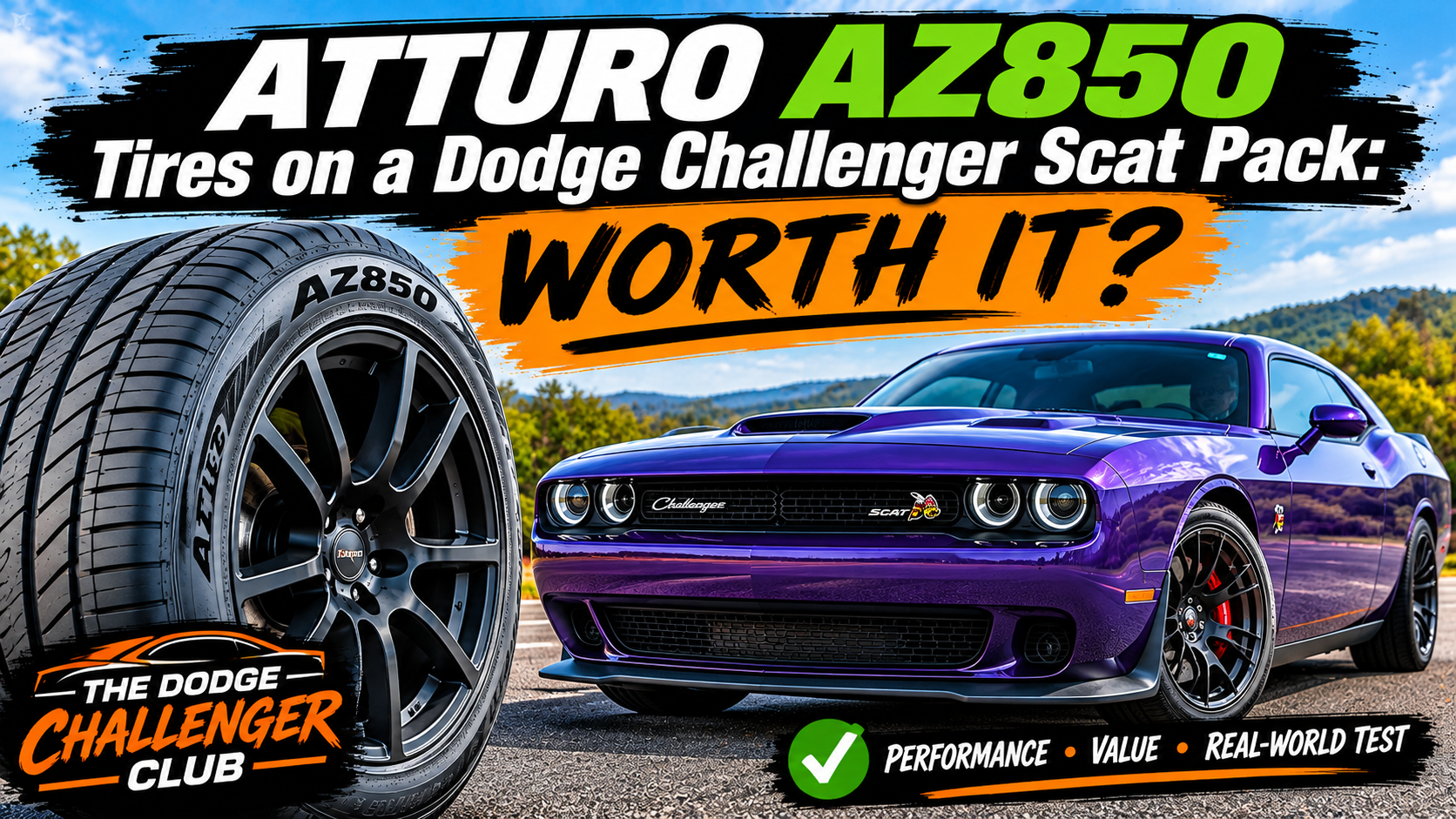
Atturo AZ850 Tires on a Dodge Challenger Scat Pack: Worth It?
If you’ve been driving your Challenger on the factory Pirelli P Zeros and wondering why all that horsepower feels like it’s going nowhere, you’re not alone. The P Zeros that come stock on the Scat Pack have earned a reputation across the Challenger community for being frustratingly slippery — and a lot of our members have already made the switch to something with more bite. The question is always: do you spend big on Michelins or Continentals, or is there a smarter way to get real grip without lighting your wallet on fire?
That’s exactly the question we’re digging into today. We recently got a first-hand look at what happens when you pull those worn-out P Zeros off a Scat Pack and bolt on a set of Atturo AZ850 tires — specifically the 315/35 ZR20s. The before-and-after difference was dramatic enough that we had to share it with the whole community. Here’s everything you need to know, including a full price comparison against the competition.
Whether you’re riding on worn stockers, shopping for your first upgrade, or just trying to decide if the Atturos are legit, this breakdown covers the real-world experience from cold launch to highway pull — and the numbers that make the decision a lot easier. Check out the full video over at Challenger Videos for the action footage, and read on for everything we pulled out of it.
The Problem With the Factory Pirelli P Zeros
Let’s be direct: the Pirelli P Zeros that come standard on the Scat Pack are not doing your Challenger any favors. At 60% throttle out of a turn, the rear end gets squirrelly with zero grip to speak of. From a dead stop, flooring it produces nothing but a smoke show — entertaining for about five seconds, but not exactly putting all those horsepower to work. The “P Zero” name has become something of a running joke in Challenger circles, with the punchline being that the zero refers to traction.
The consensus among Challenger owners is pretty clear: most people who stick with the P Zeros do so simply because they came from the factory that way. After about 14,000 miles of real-world driving — including the kind of enthusiastic throttle inputs that Scat Pack owners tend to favor — the tires are cooked. Flat spots, zero remaining tread, and a driving experience that makes you feel like you’re wasting every bit of that supercharged potential. Worth knowing before you start: if your stockers are showing any of these signs, you’re overdue.
Choosing the Atturo AZ850 — and Why Budget Doesn’t Mean Cheap
The upgrade path most Challenger owners follow leads to the Michelins, Continentals, or Nittos. All excellent tires — but the price tags are brutal when you’re buying four. That’s where the Atturo AZ850 tires entered the picture. We’d been seeing positive reviews pile up across the community, and the price point is genuinely hard to ignore. When a single competing tire costs more than your entire set of Atturos, it at least deserves a serious look.
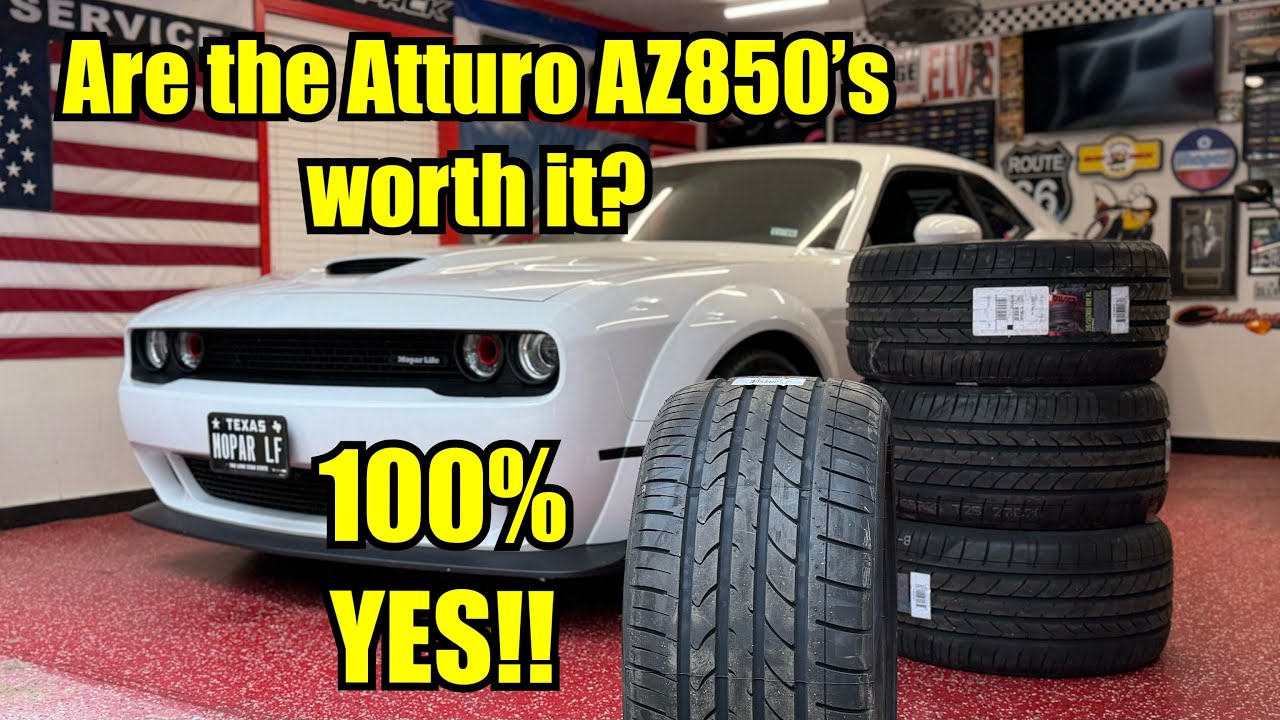
The specific size chosen here was 315/35 ZR20 — a step up from the stock 305s. Going slightly wider adds a bit more contact patch, which is part of what helps the grip story. The Atturos were sourced through the Atturo store on Amazon and arrived quickly. One thing worth noting: when checking the manufacturing dates, three of the four tires were dated from early 2025, and one was from late 2024. A year-old tire isn’t a dealbreaker if the rubber still feels fresh and supple, but it’s always smart to check the DOT date on any tire purchase.
The Before Test: What 60% Throttle Looks Like on P Zeros
Before swapping tires, we documented exactly what the Scat Pack does on the worn P Zeros, so the comparison would be apples-to-apples. At about 60% throttle through a turn, the rear breaks loose immediately — no warning, no progressive slide, just instant loss of traction. It’s the kind of handling that keeps you on your toes but doesn’t inspire confidence if you’re trying to actually use the car’s performance.
From a standing start, the result was even less impressive: a big smoke cloud and not much forward motion. Full-send launches with the Pirellis basically mean the rear tires are spinning freely while the car lumbers off the line. Great for a burnout, not so great for actually going fast. The Scat Pack deserves better than that, and so do the people driving them.
The Tire Swap: Installation and First Impressions
Getting the Atturo AZ850 tires mounted up is a straightforward job for any shop. After pulling the car onto jack stands and confirming the rears were truly done — completely flat in spots — the 315s went on clean. Visually, the difference between 305s and 315s is subtle; you’d have to look closely to notice the extra width. But what matters is the contact patch, and those extra millimeters add up when you’re putting 400-plus horsepower to the pavement.
Fresh tread always looks good on a Challenger, and the Atturos have a solid, aggressive tread pattern that fits the car’s character. If you want to browse other wheel and tire upgrades that work well with these, our Challenger Mods & Gear section is a great starting point. First impressions out of the driveway were promising — but the real test was always going to be on the road.
The After Test: Cold Tires, First Pulls
The first real-world test with the Atturos used the same turn and roughly the same throttle input as the before test — about 60%, tires still cold. The difference was immediate and noticeable. Where the Pirellis had broken loose and gone squirrelly, the Atturos held. Not perfectly — cold tires are cold tires — but the grip was there in a way it simply wasn’t before.
Pushing to about 75% throttle on a straight pull, there was no tire squeal at all. That’s a pretty significant data point on a 485-horsepower rear-wheel-drive car. Even partially warmed up, the AZ850s were already rewriting the experience of driving the Scat Pack hard. The key takeaway from cold-tire performance: even before they reach operating temperature, these are a step change over the factory rubber.
Warmed-Up Performance: Feeling the Horsepower for the First Time
Once the Atturos came up to temperature, the experience shifted again — this time dramatically. At a traffic light, feathering into the throttle and then going wide open produced a launch that, in the words of the driver, felt like the car had gained 75 to 100 horsepower. That’s not because the engine changed — it’s because for the first time, the power was actually going to the ground instead of going up in tire smoke.
The car simply took off. No chirp, no spin, no drama — just forward motion the way a Scat Pack is supposed to deliver it. Corners that previously produced immediate oversteer now allowed a quick chirp followed by confident grip. Highway pulls felt planted and stable, without the nervous, dart-y feeling the P Zeros had on road irregularities. If you’ve never driven your Challenger on a proper performance tire, this is the kind of transformation that makes owners say they should have done it the day they drove off the lot.
Launch Technique With the Atturos: The Feather-Then-Floor Method
One practical finding worth passing along to anyone making this switch: even on the Atturos, trying to floor it from a complete dead stop will still produce some wheel spin on a Scat Pack. The trick that worked consistently was feathering the throttle to get the car rolling — letting the tires load up and find grip — and then going to full throttle once momentum was established. It’s a small technique adjustment that makes a big difference in how clean the launch feels.
This isn’t unique to the Atturos; it’s really just good rear-wheel-drive driving technique. But the Atturos reward that input much more than the Pirellis did. With the P Zeros, even a careful feather-then-floor launch would devolve into wheel spin. With the AZ850s warmed up, that same input delivers a hard, clean pull that actually puts a grin on your face. A lot of our members who’ve made similar tire upgrades report the same learning curve — small adjustment, massive payoff.
Highway Feel and Ride Quality
Performance tires that grip hard sometimes come with a trade-off in ride quality — they can feel stiff, noisy, or overly sensitive to road texture. The Atturos in the 315 size struck a reasonable balance here. The ride feels firm, which is appropriate for a performance tire on a muscle car platform. What was notable is that the Pirellis had a tendency to follow every groove and rut in the pavement, pulling the car around in a way that required constant correction. The Atturos felt more neutral and planted at highway speeds.
Road noise was not flagged as an issue in real-world testing. For daily driving mixed with spirited weekend runs — which describes how most Scat Pack owners use their cars — the AZ850s seem to fit that use case well. Worth confirming for your own driving conditions and preferences, but the initial highway impression was positive.
Full Price Comparison: Atturos vs. the Competition
Here’s where the value case for the Atturo AZ850 tires gets genuinely hard to argue with. Based on Discount Tire Company pricing per tire at the time of this test, here’s what the competitive set looks like: Goodyear Eagle F1 at $330 per tire, Nitto NT555 at $363, Continental Extreme Contact Sport at $524, Michelin Pilot Sport 4S at $584, Michelin Pilot Super Sport at $644, and — perhaps most surprising — the factory Pirelli P Zero at $623 per tire. That’s right, the tires most Scat Pack owners want to get rid of cost $623 each to replace in kind.
The Atturo AZ850s, ordered through Amazon, came in at approximately $139 per tire. Four tires, taxes, and shipping to the door: roughly $600 total. Add $160 for professional mounting, balancing, and disposal of the old tires, and the all-in cost was $760. To put that in perspective, a single Michelin Pilot Super Sport costs nearly as much as this entire job. If you get even 10,000 miles out of the Atturos, the math is undeniably in their favor. For members who want to keep an eye on the best pricing and deals on gear like this, check out Challenger Deals & Perks for community-sourced savings.
Tips and Best Practices for Upgrading Your Challenger’s Tires
Check the DOT date before you accept any tire order. Tires degrade with age even if they’ve never been driven on. Most manufacturers recommend replacement after six years regardless of tread depth. When ordering online, it’s worth checking the manufacturing date stamped on the sidewall — the four-digit code tells you the week and year of production. A tire that’s a year old isn’t a dealbreaker, but anything over two to three years old warrants a closer look.
Size up thoughtfully. Going from 305s to 315s adds contact patch without requiring any fitment modifications on most Scat Pack builds, but always confirm clearances for your specific model year before ordering. Consult your factory service manual or a trusted shop if you’re unsure. If you need a shop recommendation in your area, our Find a Challenger Shop tool can help you locate someone familiar with the platform.
Warm up your tires before pushing hard. Cold performance tires — even great ones — won’t deliver their full grip potential. Give them a few miles of normal driving before you explore the upper end of the throttle. This applies to any high-performance tire, not just the Atturos.
Remember that any modification, including tires, may affect your factory warranty. Always check with your dealer and confirm that your chosen tire size and type comply with local regulations. Tire upgrades are generally straightforward, but it’s good practice to stay informed.
Frequently Asked Questions
Are the Atturo AZ850 tires a good fit for the Dodge Challenger Scat Pack?
Based on real-world testing, the Atturo AZ850 tires deliver a significant grip improvement over the factory Pirelli P Zeros on the Scat Pack. The 315/35 ZR20 fitment works well on the platform, and the performance difference — especially once the tires are warmed up — is noticeable from the first drive. For the price point, the value case is strong.
How do the Atturo AZ850s compare to Michelin Pilot Sport 4S or Continental Extreme Contact Sport?
Direct side-by-side testing on the same car wasn’t part of this evaluation, so we can’t make a definitive performance comparison. What we can say is that the Atturos cost roughly $139 per tire versus $524–$644 for the Michelin and Continental alternatives. For many Challenger owners, the grip improvement over the factory P Zeros is the primary goal, and the Atturos deliver that at a fraction of the cost.
What size Atturo AZ850 tires work on a Challenger Scat Pack?
The 315/35 ZR20 was the size used in this test, upgrading from the stock 305/35 ZR20 Pirelli P Zeros. The difference in visual stance is subtle, but the extra contact patch contributes to better traction. Always verify fitment for your specific model year and trim before ordering, and consult your factory service manual for official tire size guidance.
Where is the best place to buy Atturo AZ850 tires for a Challenger?
The tires in this test were purchased through the Atturo store on Amazon and shipped directly to the buyer’s door. The convenience and pricing were both positives. You can find them here: Atturo AZ850 tires on Amazon. Budget around $150–$160 for professional mounting, balancing, and old tire disposal at a local shop.
The Bottom Line: Real Grip, Real Value
The story here isn’t complicated: the factory Pirelli P Zeros that come on the Scat Pack are a weak link in an otherwise strong performance package. Replacing them with Atturo AZ850 tires at roughly $760 all-in — mounted, balanced, and old tires disposed of — transforms how the car feels and performs. The power was always there. The tires just weren’t letting you use it.
At $139 a tire versus $584 for a Michelin or $623 for a replacement Pirelli, the value math is hard to dispute. If you can get 10,000 or more miles out of them, you’ve spent less than the cost of one premium tire for a full set that actually works. For Scat Pack owners who want to feel what their car can really do without spending big on rubber, this is a move worth seriously considering. Want to explore more upgrade options for your build? Browse our community’s favorite picks in the Challenger Mods & Gear section — and if you’ve already made the switch to better tires, we’d love to hear about it.
Some links in this post are affiliate links, which means the club may earn a small commission at no extra cost to you. Read our affiliate disclosure.
Talk Challengers with fellow owners in our Facebook group, and got a build to show off? Submit your Challenger to the Member Garage.