
Dodge Challenger Model Year Buying Guide: 4 Years Ranked
Most people shop for a Dodge Challenger the wrong way. They fall for the paint, they check the horsepower number on the spec sheet, and they never stop to ask the one question that separates a great buy from an expensive lesson: which model year is this? Two Challengers can sit side by side at a dealer or on a private listing — same badge, same color, similar asking price — and one of them will quietly cost you thousands more than the other before the first year is out.
That’s why this Dodge Challenger model year buying guide pulls together federal NHTSA complaint data, recall records and current listings, along with the video below, to rank four key eras from most problematic to the year we’d actually spend money on — and fair warning, it’s not the year most people expect.
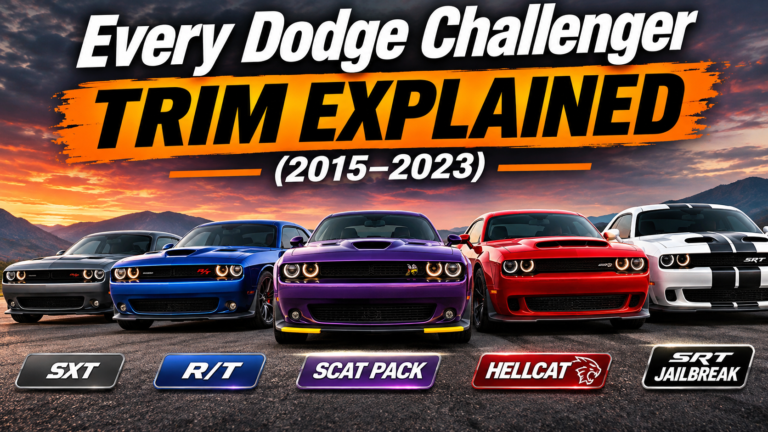
Whether you’re a first-time Challenger buyer or you’re upgrading within the community, knowing the difference between a 2010 R/T and a 2020 Scat Pack on paper — and in the federal record — could save you a serious amount of money and headache. Let’s get into it. And if you want to dig even deeper into the trim differences across the generations, our complete guide to every Dodge Challenger trim explained (2015–2023) is a great companion read to this post.
This guide draws on the video above and on NHTSA recall records. Prices are listing ranges as of November 2026 and change quickly.
Quick Reference: Challenger Model Years at a Glance
| Era | Engines and power | Recalls and complaints (NHTSA) | Typical asking prices |
|---|---|---|---|
| 2008–2010 | 5.7 HEMI R/T (372 hp), 6.1 HEMI SRT8 (425 hp) | 2010: 7 recalls, nearly 300 complaints | 2010 R/T, 60,000–90,000+ miles: $14,000–$21,000 |
| 2011–2014 | 3.6 V6 (305 hp), 5.7 HEMI (372 hp), 6.4 HEMI SRT8 (470 hp) | 700+ complaints across the four years | 2013–2014 R/T: $14,000–$18,000 |
| 2015 | Scat Pack 6.4 (485 hp), Hellcat (707 hp) | 126 complaints, 6 recalls | Hellcat: $41,000–$54,000; 2015–2016 Scat Pack: $25,000–$35,000 |
| 2020 | Scat Pack 6.4 (485 hp), Hellcat (717 hp), Redeye (797 hp) | 20 complaints, 1 recall | Scat Pack: $33,000–$43,000 |
| 2021 | Same lineup as 2020 | 18 complaints, 2 recalls | Scat Pack: $27,000–$40,000 |
Complaint counts are raw and not adjusted for sales volume. Newer cars have also had less time to collect complaints, so a lower count doesn’t guarantee a better car.
#4: The Early Cars — 2008 Through 2010
Here’s where a lot of buyers get burned. They spot a clean 5.7 HEMI R/T with low miles and an attractive price, figure it’s a bargain because it’s older and simpler, and sign the paperwork without running the VIN. Old, yes. Simple, not exactly. The third-generation Challenger arrived in 2008 with the R/T carrying the 5.7 HEMI at 372 horsepower and the SRT8 packing the 6.1 HEMI at 425. Automatics were five-speeds. The hardware isn’t the problem — the paper trail is.
The 2010 model year alone carries seven recall campaigns and nearly 300 owner complaints in NHTSA’s database, according to Carfax’s compiled data. The most serious is the driver airbag inflator recall covering roughly 88,000 vehicles from 2008 to 2010 — NHTSA campaign 15V444 — listed under the agency’s most severe warning: do not drive the car until the repair is completed. Dodge’s own notice stated the inflator housing could rupture and send metal fragments toward occupants, with humidity increasing that risk over time. Passenger-side inflator recalls were expanded multiple times after that, with NHTSA listing campaigns in 2016, 2018, and again in January 2019, when coverage expanded to more than 1.4 million vehicles across several Chrysler products. Beyond the airbag issue, there was also a 2010 recall on the ignition module (about 37,000 vehicles), another on power steering (about 23,000), and a cluster of roughly 170 engine complaints spanning 2008 to 2011, including reports of stalling without warning.
As of November 2026, Kelley Blue Book listings put most 2010 R/Ts with 60,000–90,000-plus miles at roughly $14,000–$21,000, with low-mileage examples asking considerably more — and that’s exactly where people overpay for nostalgia. What to check before buying: Run the VIN on NHTSA’s recall lookup tool and confirm every inflator recall shows as completed. Cold-start the car and watch for any stumble, stall, or hesitation. Ask for transmission fluid service records — these cars are old enough that you can’t assume it was ever done. A cheap early Challenger is only cheap once every recall is closed.
#3: The Upgrade Years — 2011 Through 2014
Buyers hear that 2011 was a big upgrade year — and it was. The 3.6 Pentastar V6 arrived making 305 horsepower, the 6.4 HEMI (the 392) replaced the 6.1 in the SRT8 and made 470, and the 5.7 R/T stayed at 372. Better hardware, so it must be a better buy, right? Not necessarily. That same federal data flags all four of these years as models to approach with caution, with more than 700 complaints across 2011–2014. Those are raw counts, not adjusted for sales volume, so treat them as a signal rather than a verdict — but it’s a signal worth taking seriously.
The signal is primarily electrical. Across 2011 to 2013, there’s a cluster of 345 electrical complaints, including a well-documented issue where windows cycle up and down on their own after the car is shut off. Owners report repair bills ranging from $190 to $480 for that problem. Autotrader’s recall listings also show alternator recalls on these years, including one where certain cars equipped with electro-hydraulic power steering could lose the alternator suddenly. Then there’s the HEMI tick, a well-known topic among Challenger owners. The 5.7 uses roller lifters riding on the camshaft, and since 2009, it has carried the Multi-Displacement System (MDS), which deactivates cylinders to save fuel. A common complaint is a tick appearing around 100,000 miles.
Sometimes it’s a broken exhaust manifold bolt — ticks cold, fades as the engine warms, relatively minor fix. Other times, a lifter roller has seized and worn a flat spot into the cam lobe, causing a persistent tick and a misfire under load. That second scenario means a cam and lifter job, which is a big, expensive repair. Same sound, completely different bills. As of November 2026, KBB listings put most 2013–2014 R/Ts at around $14,000–$18,000 with 46,000–117,000 miles, and a few low-mileage cars asking over $22,000. What to check before buying: Cold-start it and listen carefully — does the tick fade as the engine warms, or does it stay? Run every window up and down. Ask whether the battery has ever died overnight. Get oil change records, and walk away if there aren’t any. Know which tick you’re hearing before you hand over money.
#2: The Refresh Year and Early Hellcats — 2015
On paper, a 2015 Challenger looks like the best of both worlds: the new face, the redesigned interior, the ZF 8HP 8-speed automatic, and the debut of the Hellcat. Dodge changed the Challenger more for 2015 than in any year since 2008. The 6.4 became the Scat Pack at 485 horsepower and 475 lb-ft. The supercharged 6.2 HEMI Hellcat debuted at 707 horsepower and 650 lb-ft, and it came with two key fobs — the black one limiting output to 500 horsepower. That’s an extraordinary amount of hardware arriving all at once, and that’s precisely the problem.
A new transmission, new software, a supercharged engine, and updated electronics all rolled out simultaneously. Engineers test everything, but no lab matches thousands of real cars operating in winter, summer, and stop-and-go traffic over years. In March 2015, Dodge released a service bulletin to reprogram the transmission control module on early cars, addressing symptoms including a transmission that wouldn’t upshift at wide-open throttle, couldn’t reach seventh gear at highway speed, and shifted inconsistently from first to second on cold mornings. The federal record for 2015 shows 126 complaints and six recalls. The Hellcats had their own early chapter: early in 2015, Dodge recalled all 2,211 delivered Hellcats because hose seals near the fuel rail may have been installed incorrectly. In 2017, about 1,209 Hellcats built between February 6th and May 30th were recalled because an oil cooler hose could separate from its crimped aluminum fitting and spray oil — possibly onto the windshield. For more on the Hellcat, check out our 2023 Dodge Challenger Hellcat Jailbreak review.
As of November 2026, KBB listings show most 2015 Hellcats asking $41,000–$54,000, with a few low-mile manuals in the $60,000s. A 2015–2016 Scat Pack mostly lists between $25,000 and $35,000. There’s also a cluster of 50 drivetrain complaints across 2015–2017, with owners reporting carrier bearing failures anywhere from 16,000 to 110,000 miles and repairs around $2,500. What to check before buying: Run the VIN for every open recall, especially on a Hellcat. Drive it cold, then drive it hard, and note any flare, harsh shift, or hesitation from the 8-speed — ask whether the transmission updates were completed. Roll on and off the throttle at steady speeds and listen for any thump or vibration from the drivetrain. The first year of a major redesign is always when real-world owners do the final testing.
#1: The Year We’d Actually Buy — 2020 (With 2021 as a Very Close Second)
A lot of people expect us to point to the 2023 — the Last Call car, the final year of the HEMI Challenger, the collector’s edition. It’s not a bad car. But a lot of 2023s are priced like collectibles, and you’d be paying for the last-year story more than for a meaningfully better engine. We didn’t compare the 2016–2019 cars in detail here, and they can be good buys too. The year that stands out in the federal numbers we looked at is 2020.
In NHTSA’s data, 2020 comes out with the cleanest record of the years compared here: just 20 complaints, 11 of them classified as severe, and one recall. The 2021 is close behind with 18 complaints and two recalls. Compare that to nearly 300 complaints for 2010 alone. One caution: newer cars have had less time on the road to collect complaints, so part of that gap is simply age. Still, by 2020 the Challenger had spent 12 years on the same basic platform, and the 8-speed had five model years of software and mechanical updates behind it. The R/T Scat Pack carries the 6.4 HEMI with 485 horsepower and 475 lb-ft, and you could still order it with a 6-speed manual. The Hellcat made 717 horsepower by the end of the run, and the Redeye 797. Those are real engines — but the 6.4 is the one that makes the most sense as an everyday driver. It’s naturally aspirated, meaning no supercharger belt, no pulley, and no additional bearing to worry about. It gets its power from displacement alone, which means less hardware with the potential to wear or fail.
As of November 2026, KBB listings show 2020 Scat Packs ranging from about $33,000 with 60,000 miles up to around $43,000 with roughly 36,000 miles. A 2021 Scat Pack runs from about $27,000 with 100,000-plus miles to nearly $40,000 with under 30,000. The 2022 cars had a tire pressure sensor recall covering more than 50,000 Challengers, Chargers, and 300s, where a sensor battery could die early and mask a low tire — worth factoring in. What to check before buying a 2020 or 2021: Run the VIN and check whether recall 21V516 applies. It covers certain 2020–2021 Challengers, Chargers, and Chrysler 300s built between late October and early December 2020, where the windshield may not have bonded properly. If your car is on the list, confirm the urethane was replaced. Cold-start it and listen for the HEMI tick, because no model year is completely immune. Ask for service records, and skip any car with an unverified tune. If you’re looking at popular Challenger mods and gear to add after purchase, starting with a clean, recall-free baseline makes every upgrade that much more rewarding.
Tips and Best Practices: How to Buy Any Used Challenger the Right Way
No matter which model year you’re targeting, here’s the approach we’d recommend. Always run the VIN through NHTSA’s free recall lookup before you meet the seller. Recall repairs are free at any authorized Dodge dealer, but you need to confirm they were actually done. Treat an unrepaired airbag inflator recall as a deal-breaker until it’s fixed. Don’t assume a “clean” CarFax means no issues; CarFax compiles data but isn’t exhaustive. Always cold-start the car — many mechanical issues hide once an engine reaches operating temperature. The HEMI tick is the classic example, but transmission behavior and sensor faults are also more revealing on a cold start.
Ask for every service record available. Oil change intervals matter enormously on high-displacement V8s. A car without records isn’t automatically a bad car, but it’s a risk you’re taking on blind. If the car has a tune on it, ask for documentation — an unverified ECU tune can mask other issues and may have implications for emissions compliance and warranty coverage if any remains. Any modification, from an intake or exhaust to a tuner, can affect your warranty and may be subject to local emissions and noise regulations, so research your local laws before modifying.
Test drive it hard — legally and safely. The 8-speed in the 2015-and-later cars should shift smoothly and decisively. Any flare, shudder, or hesitation at wide-open throttle is worth investigating. For the drivetrain, roll on and off the throttle at steady highway speeds and listen for a thump or vibration. And if you’re buying a performance-oriented trim like the Scat Pack or Hellcat, have a trusted independent shop inspect it before purchase. Our Find a Challenger Shop directory is a good place to start if you need a knowledgeable mechanic in your area. Always confirm specs, fluid capacities, and service intervals against the factory service manual for your specific model year.
Frequently Asked Questions
What is the best model year Dodge Challenger to buy used?
Based on the NHTSA complaint and recall data compared here, the 2020 Dodge Challenger stands out as the strongest used buy, with just 20 complaints and one recall on record. The 2021 is a very close second. Both years benefited from over a decade of platform refinement and several years of 8-speed transmission updates. The 2020 R/T Scat Pack with the naturally aspirated 6.4 HEMI is particularly compelling — strong power without the added complexity of a supercharger. Keep in mind that newer cars have had less time to collect complaints.
Which Dodge Challenger years should I avoid?
The 2008–2010 cars carry the heaviest recall burden, most critically unresolved airbag inflator campaigns that NHTSA listed at its most serious warning level. The 2011–2014 cars are flagged for electrical complaints and the HEMI tick, which can range from a minor manifold bolt fix to a costly cam and lifter replacement. The 2015 model year, while significantly upgraded, was a first-year redesign with early Hellcat-specific recalls and transmission software issues. None of these are impossible buys — but they require more due diligence before purchase.
Is the 2023 Dodge Challenger worth buying as a collector car?
The 2023 Last Call Challenger is not a bad car — but many examples are priced as collectibles, meaning you’re paying for the final-year narrative as much as the hardware. The engine itself is not meaningfully better than what you’d find in a well-maintained 2020 or 2021. If you’re buying purely as an investment or collector piece, that’s a different conversation. If you’re buying to drive, the premium over a clean 2020 Scat Pack may be hard to justify on the numbers alone.
What should I check before buying any used Dodge Challenger?
Run the VIN through NHTSA’s recall lookup and confirm every open campaign is closed. Cold-start the car and listen for the HEMI tick — note whether it fades as the engine warms or persists. Test every power window. Review all available service records, particularly oil change history. Drive it at highway speeds and listen for drivetrain vibration or thump. If the car has an aftermarket tune, get documentation and understand what was changed. And have an independent mechanic inspect it before you commit, especially for higher-trim or higher-mileage examples.
The Bottom Line on This Dodge Challenger Model Year Buying Guide
Here’s the recap that matters: the 2008–2010 cars carry significant recall history. The 2011–2014 cars carry electrical complaints and the ever-present risk of a serious HEMI tick. The 2015 cars were the first year of a sweeping redesign with Hellcat-specific recalls on top. If you’re buying to drive, a 2020 or 2021 R/T Scat Pack with the 6.4 HEMI is the best-documented choice in the figures above: few complaints and recalls, a naturally aspirated V8 with no supercharger to maintain, and a 6-speed manual still available. Keep in mind that newer cars have had less time to collect complaints, so a clean record isn’t a guarantee. Check the VIN for open recalls (including the 2020–2021 windshield bonding recall), get service records, and have an independent shop inspect the car. 2018 and 2019 Scat Packs can be good buys too, but we didn’t compare their data here.
If you want to compare how the Scat Pack stacks up against the competition in performance terms, our breakdown of the Dodge Challenger Hellcat vs. Camaro ZL1 vs. Mustang is worth a read. And once you’ve found the right car, our Challenger Deals & Perks page is a good place to look for what comes next. Popular first picks include a cold air intake, ceramic coating to protect the paint, and quality floor mats to protect the interior. Welcome to the Challenger community.
Some links in this post are affiliate links, which means the club may earn a small commission at no extra cost to you. Read our affiliate disclosure.
Talk Challengers with fellow owners in our Facebook group, and got a build to show off? Submit your Challenger to the Member Garage.