Dodge Challenger Hellcat vs Camaro ZL1 vs Mustang: Who Wins?
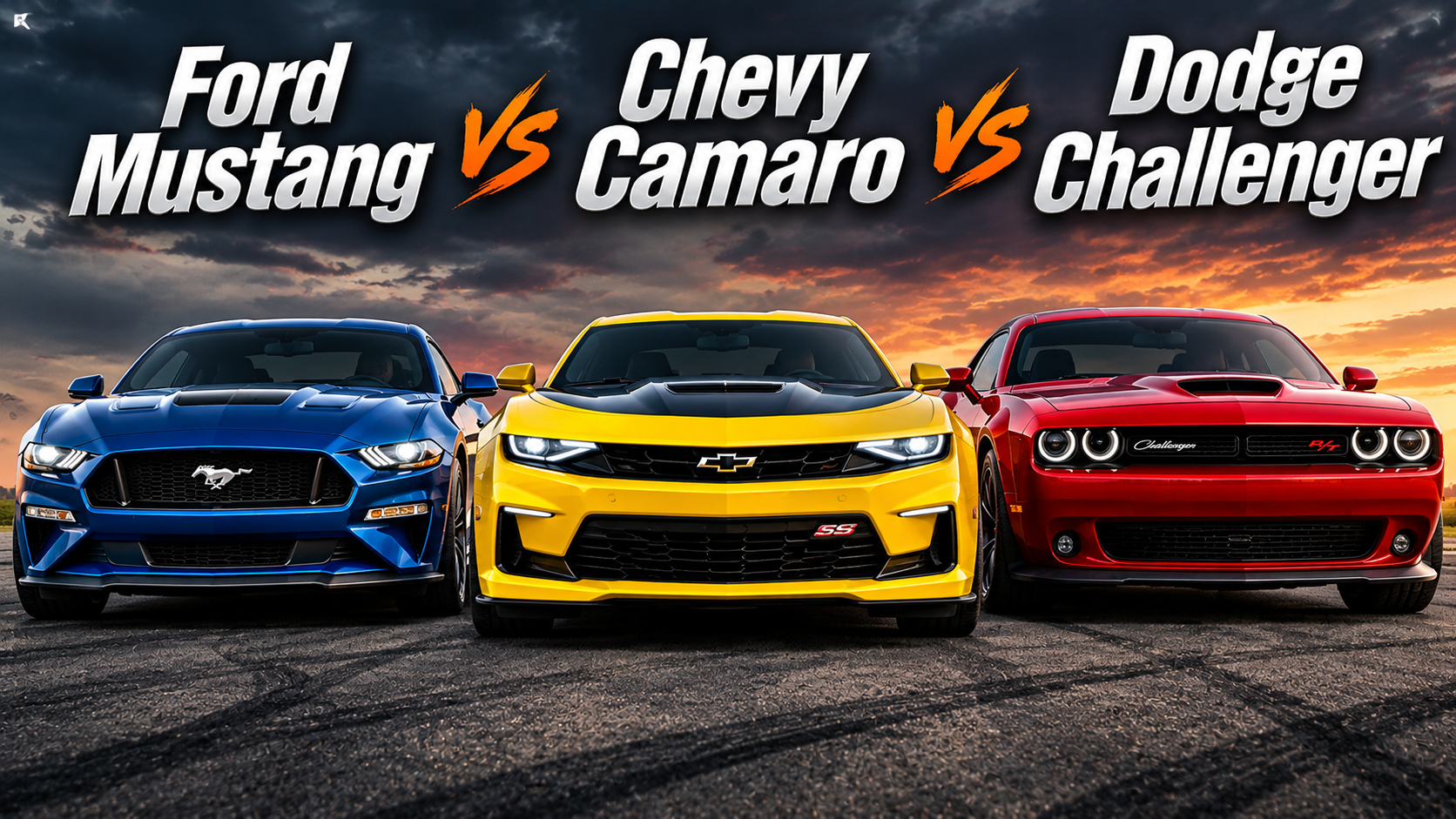
Three of the most iconic American muscle cars — the Dodge Challenger Hellcat Redeye, a tuned Chevrolet Camaro ZL1, and a supercharged Ford Mustang 5.0 — lined up for a proper showdown: standing quarter mile drag race, a rolling race from 50 mph, and a full brake test from 100 mph. As a community that lives and breathes the Challenger, we find matchups like this genuinely fascinating. Not because we’re rooting against anyone, but because understanding where our cars shine — and where they face real competition — makes us better, more informed owners.
What makes this particular comparison so interesting is that none of these cars showed up on equal footing. The Camaro and the Mustang both brought modifications to the table, while the Challenger Hellcat Redeye ran completely stock. That tells its own story. We’ll walk through every stage of the competition — the specs, the sound check, the drag race drama, the rolling races, and the brake test — so you get the full picture of how these three stacked up.
Whether you’re a proud Hellcat owner, considering a build, or just want to know how your car compares to the best GM and Ford have to offer, this breakdown has everything you need. Let’s get into it.

The Contenders: Specs and Setup
Before any racing happened, it’s worth understanding exactly what each car brought to the line. The Chevrolet Camaro ZL1 runs a 6.2-liter supercharged V8 that in stock form makes around 650 horsepower — but this particular example had been tuned up to 770 horsepower and 1,000 Newton-meters of torque. It sends all that power to the rear wheels through a 10-speed automatic gearbox and weighs in at approximately 1,750 kg. In UK pricing terms, it was valued at around £70,000.
The Dodge Challenger Hellcat Redeye also uses a 6.2-liter supercharged V8, but here’s the key detail our community loves: it was completely stock. Standard output is 800 horsepower and 960 Newton-meters of torque, sent to the rear wheels via an 8-speed automatic. The Challenger is the heaviest of the three at right around 2,000 kg (roughly 2 tons), and in the UK market it carries a significantly higher price tag of approximately £130,000. The Mustang, meanwhile, started life as a naturally aspirated 5.0-liter GT but had a supercharger added, bringing it to 850 horsepower and 900 Newton-meters of torque. It’s the lightest of the three at around 1,720 kg and drives through a six-speed manual gearbox.
The Sound Check: Exhaust Notes Compared
Before the racing started, the three cars squared off in an informal sound check — each car revving out so everyone could hear what it brought to the table. The Camaro ZL1 sounded strong, pulling all the way to around 6,500 rpm with a satisfying supercharged bark. The Challenger Hellcat Redeye followed and absolutely delivered on sound — right up until it hit its rev limiter, which cut things off a bit prematurely and drew some good-natured ribbing from the group.
The Mustang, however, took the sound check decisively. The supercharged 5.0 let out a genuinely impressive roar, and the acknowledgment was pretty much unanimous — the aftermarket exhaust fitted to that car gave it a serious edge in the audio department. It’s a good reminder for our community: if the Challenger’s soundtrack matters to you (and for most of us, it really does), a quality cat-back exhaust upgrade can take what’s already one of the best-sounding muscle cars on the road to another level entirely. Check out our Challenger Mods & Gear section for community-tested options.
The Standing Quarter Mile Drag Race: Results and Drama
The first competition was the one everyone came for: a standing quarter mile from a dig. The Mustang got away well despite its manual gearbox — the driver reported using the launch control setup and working hard to find the right balance point between brake and throttle. The Challenger launched with some rear-end stepping out, as you’d fully expect from 800 horsepower going to the rear wheels on street tires. The Camaro also had a moment off the line before finding grip.
The official quarter-mile results told a clear story: the Ford Mustang ran a 12.5-second quarter mile, the Dodge Challenger Hellcat Redeye ran 12.7 seconds, and the Camaro ZL1 ran 12.9 seconds before it had to be retired from further racing due to a mechanical issue — an engine management light and misfire that ended its day early. Worth noting: the Challenger was the only stock car in this group, and it still split the gap between a tuned Camaro and a supercharged Mustang. That’s not nothing.
The Camaro’s Mechanical Retirement
After the first drag race, the Camaro ZL1 developed a misfire and triggered an engine management warning light. It had been running strong — reportedly even pulling ahead briefly before the finish line — but it couldn’t continue under full power. The car was retired from the remaining races, which meant the rolling race and brake test would be contested between just the Challenger Hellcat Redeye and the supercharged Mustang.
This is actually a worthwhile reminder for anyone running modified or heavily tuned cars: pushing a tuned powertrain hard on a track or drag strip is a different animal from street driving. The Challenger’s reliability as a stock, factory-engineered package came through here — it finished every stage of the competition under its own power. If you’re ever considering upgrades like a cold air intake or an ECU tuner, keep in mind that tuning always comes with added stress on the drivetrain, and it’s worth doing your research and confirming everything against your factory service manual for your specific model year.
Rolling Race Round 1: Comfort/Street Mode from 50 mph
With the Camaro sidelined, the first rolling race went head-to-head between the Challenger Hellcat Redeye and the supercharged Mustang. Both cars started in their more relaxed drive modes — Comfort or Street — and rolled up to 50 mph before the launch call. The Mustang’s driver dropped from sixth gear down to third on the kickdown, which resulted in a slower-than-ideal shift. The Challenger’s 8-speed automatic handled the kickdown more smoothly, but the Mustang’s higher peak power and lighter weight told in the end.
The Mustang took the rolling race in this configuration, with the Challenger’s automatic doing its job but not quite bridging the gap. The Mustang driver acknowledged the downshift wasn’t as fast as it could have been given the tight gear gate on the manual transmission, suggesting there was more time left on the table in that run. Still, a win’s a win.
Rolling Race Round 2: Sport/Manual Mode from 50 mph
For the second rolling race, both cars switched to their sportiest available settings with manual gearbox mode engaged where applicable. The Challenger went into its more aggressive drive mode, and the Mustang’s driver was now more confident with the gear change. This time the Challenger pulled a noticeably better run — the launch and acceleration felt cleaner — but the Mustang still edged it out.
One interesting detail that came up: in third gear at 50 mph, both cars were pulling almost identical revs (around 3,300 rpm), meaning the gearing was more comparable than it might appear on paper. With 850 hp vs. 800 hp and a significant weight advantage for the Mustang, the outcome was predictable — but the Challenger was closer than the raw numbers might suggest. For our members interested in squeezing more from their own cars in rolling race situations, upgrading tires for better rolling traction is one of the most effective first steps before touching power mods.
Rolling Race Round 3: Mustang Fixed, Third Gear Roll
After the Mustang’s own car threw up a warning light mid-session (requiring a restart to clear), a third rolling race was run — this time specifically from 50 mph in third gear for both cars. With the Mustang back up and running cleanly, the race was on again. The Challenger, running its sportiest setting, made a strong effort but the Mustang continued to demonstrate its advantage in the rolling race format, taking this round as well.
The pattern across all three rolling races was consistent: the Mustang’s power-to-weight advantage made it the stronger car once both cars were already moving. Where the Challenger has its strongest case is in the overall package — the torque delivery, the automatic gearbox making launches more accessible, and the fact that it ran every race completely stock while the opposition needed modifications to get to those power levels.
The Brake Test: 100 mph to a Stop
The final competition was a brake test from 100 mph. Both cars hit the anchors hard, and the result was pretty decisive — the Mustang stopped noticeably shorter than the Challenger. Given the Challenger’s significantly greater weight (roughly 280 kg heavier than the Mustang), this isn’t a surprise, but it is a real-world consideration. The Hellcat Redeye’s mass is one of its defining characteristics — that planted, substantial feel on the road — but it does mean longer braking distances compared to lighter rivals.
For Challenger owners who track their cars or push them on canyon roads, this is a meaningful data point. Factory Brembo brake packages on the Hellcat and Redeye are genuinely capable, but keeping your braking hardware in top condition matters. Fresh pads, properly bedded rotors, and quality tires with good dry-weather grip will help you get the most from the Challenger’s stopping power. You can also explore build options and brake upgrades shared by fellow owners over in our Member Garage.
Tips and Best Practices for Challenger Owners Watching This Matchup
Stock vs. modified isn’t always a fair fight, but context matters. The Challenger Hellcat Redeye ran every stage of this competition completely standard — no tune, no intake swap, no exhaust — and still finished second overall in the drag race, ahead of a Camaro that needed 770 horsepower to stay in the conversation. That’s a genuinely strong baseline. If you’re ever at a track day or informal meetup, knowing what your stock car can do is the starting point for every future build decision.
Weight is the Challenger’s biggest performance trade-off. The Redeye is around 2 tons — that’s roughly 280 kg more than the Mustang and 250 kg more than the Camaro. In drag racing, that weight costs you in 60-foot times; in rolling races, it costs you in top-end acceleration; in braking, it costs you in stopping distance. Mods that reduce rotating mass (wheels, brake rotors) or improve traction (upgraded tires) tend to have an outsized effect on Challengers for exactly this reason.
Launch control and line lock are your friends at the strip. Both the Mustang and Challenger drivers mentioned managing the launch carefully — the Challenger’s 8-speed makes it more forgiving, but getting the most from line lock and launch control mode takes practice. If you’re planning a track day, we’d encourage you to check out builds and tips from experienced drag runners in the Member Garage. Always remember that track-day mods including tunes and exhaust changes may affect your factory warranty, and some modifications are restricted by local emissions and noise regulations — check the rules in your area before modifying.
Sound is part of the Challenger’s identity. The Mustang won the sound check largely because of its aftermarket setup. The Hellcat Redeye is already one of the best-sounding muscle cars ever built, but a well-chosen cat-back exhaust can make it even more memorable. Browse community picks over at Challenger Mods & Gear to see what other owners are running. And if you’re shopping for deals on parts and accessories, don’t miss our Challenger Deals & Perks page.
Frequently Asked Questions
How fast did the Dodge Challenger Hellcat Redeye run the quarter mile in this race?
The Challenger Hellcat Redeye ran the standing quarter mile in 12.7 seconds, finishing second behind the supercharged Ford Mustang (12.5 seconds) and ahead of the tuned Camaro ZL1 (12.9 seconds before retirement). Crucially, the Challenger was the only completely stock car in the group.
Why did the Camaro ZL1 get retired from the race?
After the first drag race, the Camaro ZL1 developed a misfire and an engine management warning light, which prevented it from running at full power. It was retired from the rolling races and brake test as a result. The car had been tuned to 770 horsepower — well above its stock 650 hp — which likely contributed to the drivetrain stress.
How does the Challenger Hellcat Redeye’s weight affect its performance against lighter rivals?
The Challenger Hellcat Redeye weighs approximately 2,000 kg, making it significantly heavier than both the Camaro ZL1 (1,750 kg) and the Mustang (1,720 kg). That extra mass hurts launch times off the line, acceleration in rolling races, and braking distances from high speed. It’s the primary reason why a stock Challenger was competitive but not dominant against modified, lighter rivals in this test.
What modifications could help close the gap between a stock Hellcat and these rival cars?
Based on what this test highlighted, the most impactful starting points would be better tires for improved launch traction, a cold air intake for more efficient airflow, and an ECU tuner to optimize the power delivery — though as always, tuning should be done by a reputable shop, confirmed against your factory service manual, and with awareness of warranty and local regulations. Find trusted builders near you through our Find a Challenger Shop directory.
The Bottom Line
When the dust settled on this three-way showdown, the supercharged Ford Mustang came out on top across the board — quickest in the quarter mile, fastest in the rolling races, and shortest stopping distance in the brake test. But the Dodge Challenger Hellcat Redeye earned something arguably more impressive: it was the only stock car at the event, it finished every single test, and it sat right in the middle of the results, ahead of a heavily tuned Camaro that needed 770 horsepower just to show up competitively.
For us as a community, that’s the story worth telling. The Hellcat Redeye is a remarkable machine straight from the factory — a car that can genuinely challenge serious rivals without a single modification. And when you do start building on that foundation, the ceiling is extraordinary. Whether you’re running stock and loving every second of it, or deep in a build chasing more, the Challenger stands tall in any company.
Got a Hellcat, Redeye, or Demon build you’re proud of? We’d love to see it — submit your Challenger to the Member Garage and join the conversation. This is what our community is built on.
Some links in this post are affiliate links, which means the club may earn a small commission at no extra cost to you. Read our affiliate disclosure.
Talk Challengers with fellow owners in our Facebook group, and got a build to show off? Submit your Challenger to the Member Garage.