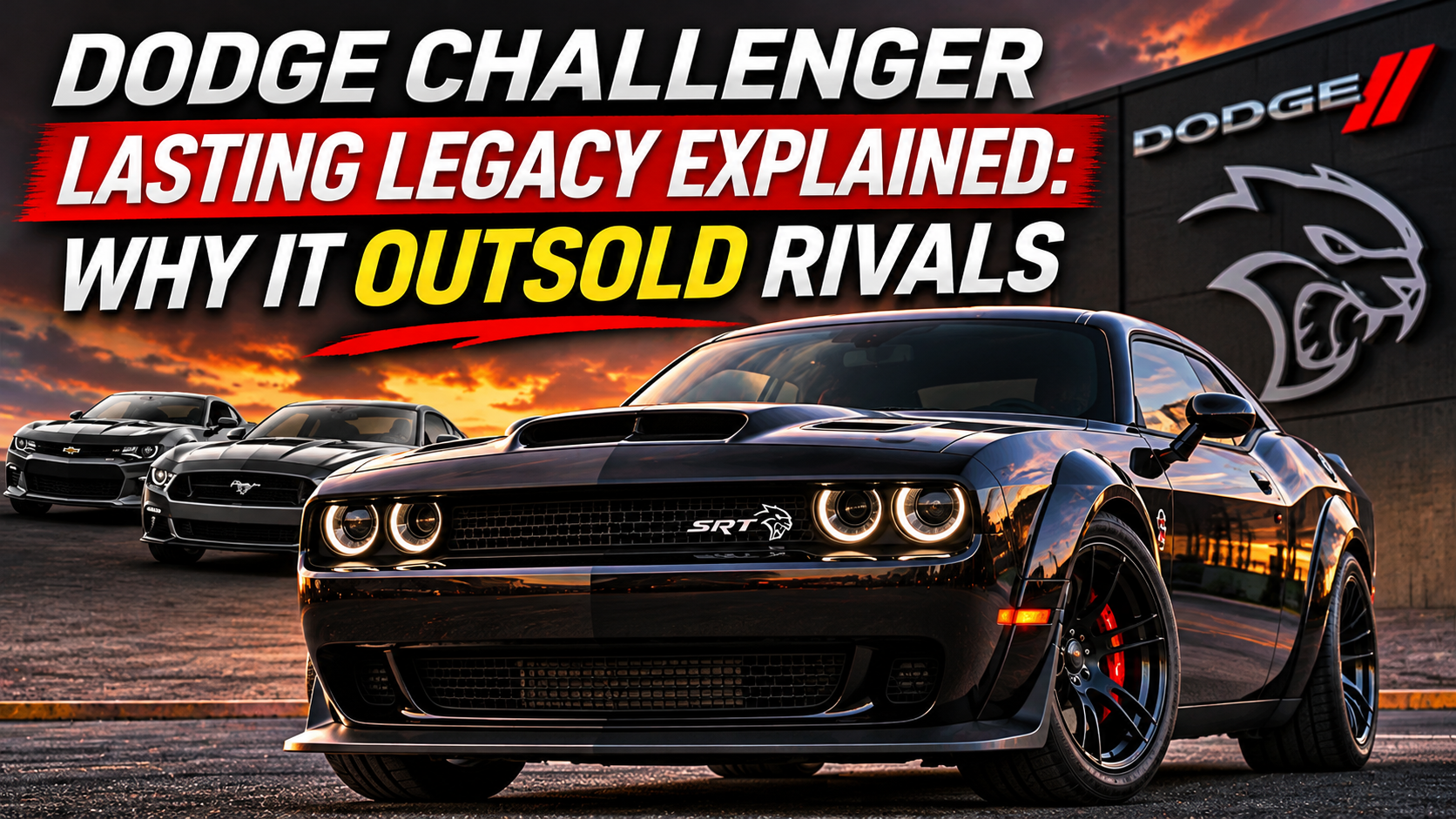
Dodge Challenger Lasting Legacy Explained: Why It Outsold Rivals
By 2022, every analyst with a spreadsheet had a reason to write the Dodge Challenger off. Its basic shape dated back to 2008. The Mustang had been fully reinvented. The Camaro had evolved into a genuinely capable performance machine. And yet the oldest contender in the room outsold them both. That’s not a footnote — that’s the whole story, and it’s one we in the Challenger community lived through with pride.
So how does a car survive 16 model years, grow more desirable with every passing season, and then exit the stage with a quarter-mile time that embarrassed purpose-built race cars? The Dodge Challenger lasting legacy explained isn’t really about lap times or platform refresh cycles. It’s about understanding what muscle car buyers actually want — and then delivering it, relentlessly, all the way to the very last car off the Brampton assembly line. That’s what this post is all about.
We’ve pulled together the full story from a detailed video breakdown covering the Challenger’s design origins, its landmark model years, its explosive performance escalation, and the sales figures that backed it all up. Whether you’re a longtime owner or someone who just fell in love with the breed, this is the Dodge Challenger lasting legacy explained in full — from the 1970 original to the pitch-black Demon 170 that closed the curtain on December 22nd, 2023.
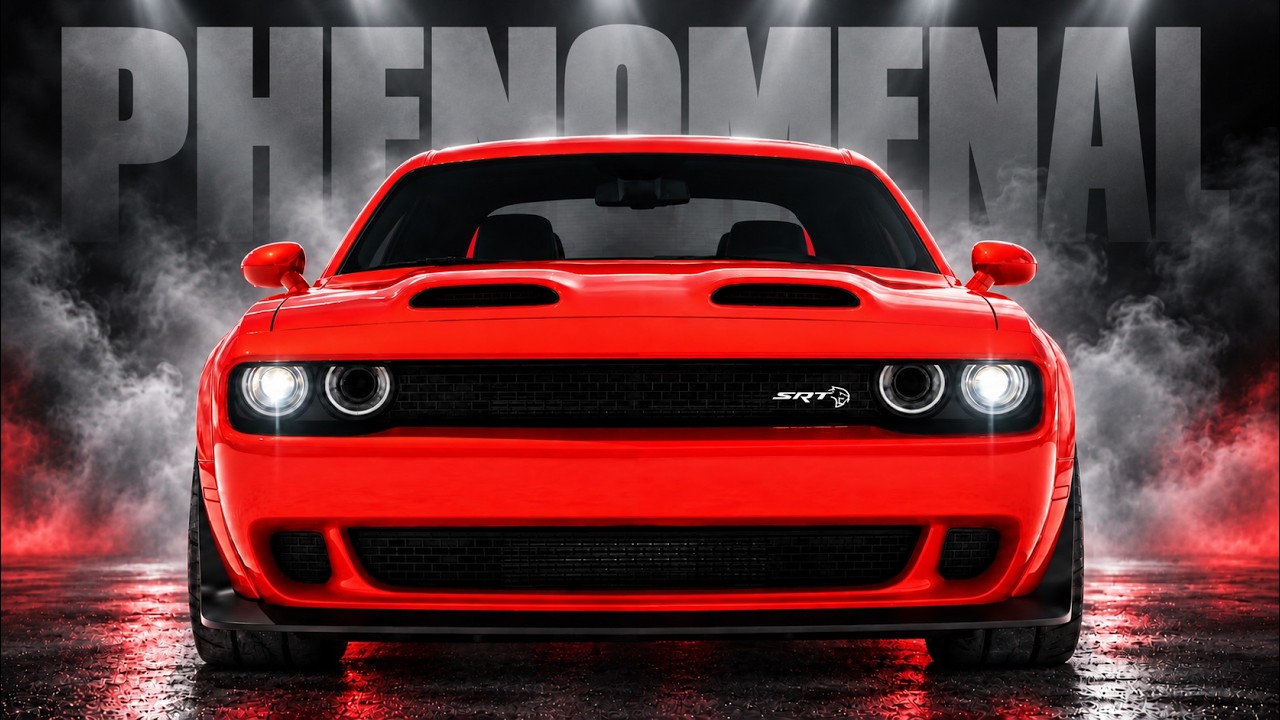
Based on the video above. Specs, prices and dates are as stated in the video and may have changed, so confirm anything important before you rely on it.
The Original 1970 Challenger: Late to the Party, But It Brought Presents
The first Dodge Challenger arrived for the 1970 model year, stepping into a pony car segment already dominated by the Mustang and Camaro. But as the video’s host explains, it didn’t show up empty-handed. It brought a broad stance, a long hood, and an engine lineup that included the legendary 426 Hemi — hardware that immediately gave it credibility on the street and the strip.
The party didn’t last long. Changing emissions regulations, rising insurance costs, and the fuel crisis of the early 1970s choked the life out of the muscle car era. The original Challenger disappeared after 1974. The badge briefly reappeared on a Mitsubishi-based coupe, but the V8 legend went dormant — waiting, as it turned out, for exactly the right moment to come roaring back.
The Mid-2000s Retro Wave That Made the Revival Possible
American retro design found its momentum again in the mid-2000s. Ford showed in 2005 that heritage could still sell cars — the Mustang’s retro-influenced redesign proved buyers would line up for a car that looked like their childhood poster brought to life. Dodge had its own powerful history and already had rear-wheel-drive hardware supporting the Charger and Chrysler 300. According to the video, those ingredients came together at the 2006 Detroit Auto Show in the form of a bright orange Challenger concept.
That concept, as the video’s host describes it, looked like someone had pulled a childhood poster off the wall and made it real. The bones were there: the right platform, the right corporate will, and suddenly, the right cultural moment. The Challenger wasn’t a desperate cash-grab revival. It was a carefully timed return.
The Design Process: Recovering Visual Drama Within Modern Constraints
Getting from the idea to the showroom required serious design work. According to the video, exterior designer Michael Castiglione and interior designer Alan Barrington developed the concept at Chrysler’s Pacifica Studio, with an actual 1970 Challenger brought in as a physical reference. The challenge wasn’t copying headlights — it was recovering the visual drama of the original while working within the packaging demands of a modern platform.
The video’s host walks through the design geometry in impressive detail. If you draw a line straight down from the A-pillar on the production Challenger, it connects directly to the center of the front axle — almost exactly mirroring the proportions of the 1970 car. The distance from the rear axle to the end of the greenhouse is nearly identical between the original and the modern version. Four headlights sit deep inside a wide dark opening. The hood reads as one enormous unbroken surface. The shoulders flow into muscular rear quarters that give the car what the host calls “a sense of stored energy just waiting to be unleashed.” The body is intentionally simple — your eye reads the whole shape before it starts counting details, and that restraint is exactly why the design aged so well.
Concept to Production: What Changed and What Didn’t
The concept featured a pillarless hardtop and carbon fiber bodywork — both production impossibilities. So compromises were made. The B-pillar became fixed. Reflector lights moved to a lower position front and rear. Door handles appeared where the concept had none. But according to the video’s host, everything else made it to the showroom essentially unchanged, and that fidelity to the concept was highly unusual for the mid-to-late 2000s era of automotive development.
We’d argue this is one of the most underappreciated facts in modern American automotive history. Most concepts get watered down beyond recognition. The Challenger didn’t. The essential silhouette — that dramatic, wide, long-hooded shape — survived the production process almost completely intact. That’s why owners fell in love the moment they saw it on the dealer lot, and it’s a huge part of the Dodge Challenger lasting legacy explained.
The 2008 Launch: SRT8 and the Difficult Part Done Right
When the production Challenger arrived for 2008, it launched as the SRT8 — powered by a 6.1-liter Hemi V8 making 425 horsepower. As the video’s host puts it, Dodge had managed the difficult part: the showroom car still looked like the dream. It wasn’t a compromised shadow of the concept. It was the concept, made driveable.
Critics were quick to point out that the Challenger was big and heavy. Those criticisms weren’t wrong. But the video makes an argument we find completely valid: that size also gave buyers something genuinely valuable. You could take friends along. You could pack luggage for a road trip. You could settle into long highway drives without punishing your passengers. For a performance coupe, it was unusually accommodating — and that matters enormously when your dream car also has to be your everyday car. The Challenger understood that muscle car buyers live real lives.
The 2015 Refresh: A New Interior, a New Face, and a New Identity
The early interiors were widely acknowledged as the car’s weak point — they didn’t match the promise of the exterior. The major 2015 refresh addressed that head-on. According to the video, Dodge introduced a new driver-focused dashboard, an available 8.4-inch Uconnect touchscreen, and an 8-speed automatic transmission. Outside, a redesigned split grille and split taillights drew direct inspiration from the 1971 Challenger. The design evolved without losing its identity — it still offered proper gauges, physical controls, and a cockpit that wrapped around the driver.
But the real headline of 2015 wasn’t the interior or the grille. It was the Hellcat.
The 2015 Hellcat: 707 Horsepower With a Warranty
The 2015 Hellcat supercharged 6.2-liter V8 made 707 horsepower — from a factory-built Dodge you could buy at a dealership, with a full warranty. As the video’s host explains, this wasn’t just an engineering achievement. It was theater. Even the keys became part of the story: the black key limited engine output, while the red key unlocked the Hellcat’s full potential. It was brilliant showmanship backed by very real performance engineering, and it completely changed the Challenger’s reputation in the broader automotive world.
For those of us in the Challenger community, 2015 feels like a turning point. Before the Hellcat, the Challenger was beloved. After the Hellcat, it was legendary. If you’re a Hellcat owner, it’s worth noting that any modifications — especially to the supercharger, tune, or exhaust — can affect your factory warranty, and some performance modifications may be restricted by local emissions and noise regulations. Always confirm what’s covered before you wrench.
The Performance Escalation: Demon, Redeye, Super Stock, and Widebody
Once Dodge opened the horsepower door with the Hellcat, they kept pushing it wider. The 2018 Demon was built around the drag strip. According to the video, it made 808 horsepower on premium fuel and 840 horsepower with the appropriate high-octane fuel and configuration. Production was deliberately limited to 3,300 cars. The Hellcat Redeye followed with 797 horsepower. The Super Stock took the obsession even further with 807 horsepower and drag-focused hardware. Widebody versions added broader fenders and wider tires across multiple variants, helping the car put its power down while making the original shape feel even more imposing.
As the video’s host notes — and we’d wholeheartedly agree — the Widebody Challenger stands as one of the best-looking cars produced in the last 50 years. Every new variant gave enthusiasts another reason to talk about a car they already knew and loved, while the fundamental silhouette remained familiar and unmistakable. If you own a Widebody, we’d love to see it in the Member Garage.
The Full Lineup: Something for Every Challenger Fan
Not every Challenger buyer was chasing drag strip records, and Dodge understood that perfectly. By its final years, the lineup covered remarkable ground. The SXT and GT offered a 303-horsepower V6 with available all-wheel drive — genuinely practical entry points into the Challenger experience. The R/T delivered the classic Hemi soundtrack from a 5.7-liter V8 making 375 horsepower. The Scat Pack’s naturally aspirated 6.4-liter brought 485 horsepower along with an available manual transmission. And above that sat the Hellcat family, with standard Hellcats producing 717 horsepower in later years, and the Redeye and Jailbreak configurations reaching still higher.
According to the video’s host, the Scat Pack Widebody represents the sweet spot of the lineup — big response, big noise, available manual, and enough performance to make an ordinary commute feel like an occasion. We’d agree it’s a compelling argument. Beyond trims, Dodge offered Shaker hoods, TA packages, heritage colors, and stripe packages that let buyers personalize their car through the order sheet rather than waiting for limited edition luck. These weren’t all separate limited runs — they were accessible ways to buy deeper into the same identity at different price points.
The Sales Numbers: Outselling the Mustang and Camaro
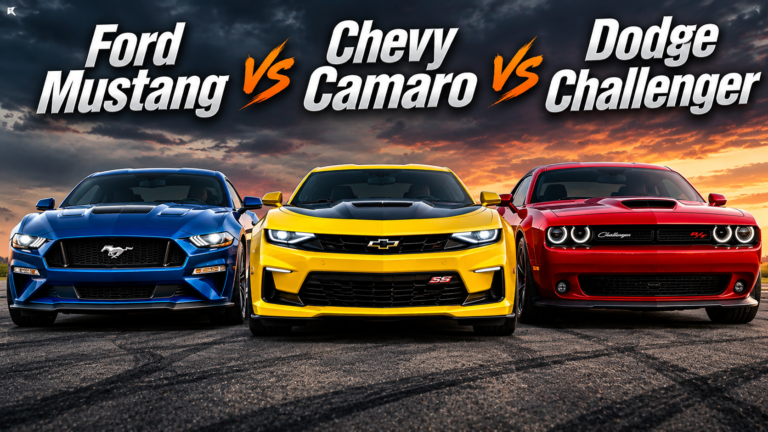
Here’s where the Dodge Challenger lasting legacy explained gets its most concrete validation. In 2021 and 2022, the Challenger led both of its traditional rivals in US sales. According to the video, in 2022 Dodge sold 55,060 Challengers, while Ford sold 47,566 Mustangs and Chevrolet moved just 24,652 Camaros. An aging platform, outselling a freshly redesigned Mustang and a highly capable Camaro — that’s a remarkable commercial achievement.
The video’s host is appropriately careful here, and so are we: the Mustang did regain the sales lead in 2023, and pandemic-era supply constraints affected the entire market in ways that complicate direct comparisons. Sales totals alone don’t prove exactly why every buyer chose Dodge. But the pattern across multiple years is real, and it reflects something genuine about what the Challenger offered that its rivals couldn’t match.
Why the Challenger Stayed True While the Mustang and Camaro Evolved
The video’s host offers a reading of the Challenger’s appeal that we find persuasive: while the Camaro and Mustang gradually transformed into sports cars — increasingly sophisticated, corner-focused, and track-oriented — the Challenger never wavered from its identity as a proper American muscle car. It didn’t particularly care about lap times or handling benchmarks, because that was never the assignment. It was a theatrical, big, rear-wheel-drive American coupe, and it committed to that identity completely.
As the video explains, a Demon at the top of the lineup made even a V6 Challenger feel connected to something genuinely outrageous. That halo effect is powerful. The old design actually helped preserve that promise — you knew exactly what a Dodge Challenger was, and Dodge kept giving you more of it. Special editions from the Mopar ’10 to the 50th Anniversary Edition kept the heritage alive throughout the production run, giving the community constant reasons to celebrate what made the car special.
The Last Call Special Editions: A Farewell Done Right
For 2023, the farewell became official under the Last Call banner. According to the video, the Challenger Shakedown and Scat Pack Swinger each received 1,000-car production runs. Then came the Black Ghost — just 300 cars, honoring Godfrey Qualls’ legendary 1970 Challenger street racer, complete with a gator-skin-style roof treatment and 807 horsepower.
These weren’t just trim packages. They were Dodge acknowledging the community and the history that made the Challenger matter — a proper send-off for a car that had earned it. If you were lucky enough to secure a Last Call car, you own a piece of that history.
The Demon 170: Over 1,000 Horsepower as a Final Statement
The Demon 170 was the Challenger’s final act, and it was extraordinary. According to the video, on high-ethanol fuel it produced 1,025 horsepower and 945 lb-ft of torque, covering the quarter mile in 8.91 seconds. The video’s host is clear that this was a prepared drag strip achievement requiring the right fuel and conditions — not something you’d replicate from a normal street launch. But the achievement itself, from a production car, was genuinely historic.
The final Challenger built at the Brampton Assembly Plant rolled off the line on December 22nd, 2023 — a pitch-black Demon 170. As the video’s host puts it, it was a fitting ending for a car that spent its entire life making excess feel irresistible. We couldn’t have written a better closing chapter ourselves.
Tips and Best Practices for Challenger Owners Keeping the Legacy Alive
Whether you’re driving a 2008 SRT8 or a 2023 Scat Pack, here’s what we’d keep in mind as a community:
Know your trim’s power source. Horsepower figures vary significantly by trim, model year, and in the case of the Demon 170, by fuel type. Always confirm specs against your factory service manual for your specific model year rather than relying on general figures. The difference between E85 and premium pump gas can mean hundreds of horsepower on some variants.
Respect the warranty implications of modifications. The Challenger’s broad lineup means there’s a right mod for almost every goal — but modifications can and do affect factory warranty coverage. Some performance upgrades may also be restricted by local emissions regulations or noise ordinances. Do your research before you commit, and check with a qualified shop that knows Challengers specifically.
Celebrate what the car is, not what it isn’t. The Challenger was never trying to out-corner a Camaro SS or match a GT500 on a road course. Its identity was always about presence, power, and that irreplaceable feeling when a Hemi wakes up. Build, drive, and enjoy it on those terms, and it will never disappoint.
Frequently Asked Questions
Why did the Dodge Challenger outsell the Mustang and Camaro despite being an older design?
According to the video, the Challenger’s appeal came from its unwavering commitment to the muscle car identity — broad proportions, a classic Hemi soundtrack, usable interior space, and a lineup that ranged from practical V6 models all the way to 1,000-plus horsepower Demon variants. While the Mustang and Camaro evolved toward sports car handling and sophistication, the Challenger kept serving buyers who wanted a theatrical, big American coupe. That consistency, combined with a strong halo effect from high-horsepower variants, helped drive sales even as the platform aged. In 2022, Dodge sold 55,060 Challengers compared to 47,566 Mustangs and 24,652 Camaros.
What made the Challenger’s design hold up for 16 model years?
The video’s host attributes the design’s longevity to its intentional simplicity. Every line and surface serves the overall shape rather than chasing styling trends. The proportions — long hood, broad shoulders, muscular rear quarters — were drawn almost directly from the original 1970 Challenger’s geometry, and they were strong enough to remain compelling without constant revision. In an era of over-styling, restraint proved durable.
What were the Demon 170’s performance figures, and what do they require?
According to the video, the Demon 170 produced 1,025 horsepower and 945 lb-ft of torque on high-ethanol fuel, with a quarter-mile time of 8.91 seconds. The video’s host is explicit that these figures represent a prepared drag strip achievement with the correct fuel and conditions — not results you should expect from a cold street launch. If you own a Demon 170, confirm all operational requirements in your factory documentation before attempting performance runs.
Is the Dodge Challenger still being produced?
No. According to the video, the final Challenger was built at the Brampton Assembly Plant on December 22nd, 2023 — a pitch-black Demon 170. The 2023 model year was the last for the Challenger nameplate in its current form. The Last Call special editions, including the Black Ghost and Demon 170, marked the official farewell to the production run.
The Dodge Challenger’s story is one of the most compelling in modern American automotive history — a car that understood its audience completely, never apologized for what it was, and exited on its own terms with over 1,000 horsepower. That’s the Dodge Challenger lasting legacy explained in full. If you’re a proud owner keeping that legacy alive in your driveway, we’d love to hear about your Challenger and what it means to you. The legend doesn’t end when production does — it lives on every time that Hemi turns over.
Related Reading
- Every Dodge Challenger Trim Explained (2015–2023): Complete Guide
- 2023 Dodge Challenger Hellcat Jailbreak Review: What You Need to Know
- Hellcat Coming Back 2028: Has Dodge Lost Their Mind With This?
Some links in this post are affiliate links, which means the club may earn a small commission at no extra cost to you. Read our affiliate disclosure.
Talk Challengers with fellow owners in our Facebook group, and got a build to show off? Submit your Challenger to the Member Garage.